Inside Our Patented Dosing Mechanism: How the Protein Dispenser Stops Leaks and Doses Consistently
Search ‘protein dispenser’ online and you’ll find plenty of options. Most look the same from the outside, but the difference is what happens inside, and whether it actually works.
The ALENNE Protein Dispenser was granted a Japanese patent on its dosing mechanism (Japan Patent No. 7580860). Filed in May 2024 and registered after more than six months of examination, the design was confirmed as structurally independent from prior US patents in the same category.
Below: what’s new, and how it works.
The Two Problems Most Dispensers Don’t Solve
Why was a patent necessary at all? Because the powder dispensers on the market today still leave two problems unsolved.
Leakage
In any dispenser that uses a lever or handle to push powder out, some powder leaks past the moving parts. Over time, that leaked powder accumulates in gaps around the mechanism and eventually escapes to the outside through the lever port. Fine, free-flowing powders like protein make this worse.
Competitor reviews often include something like: “I put it on the counter and there was powder everywhere.”
For more on why protein scatters and what to do about it, see The Protein Spill Problem: Let’s End It.
Dose Variance
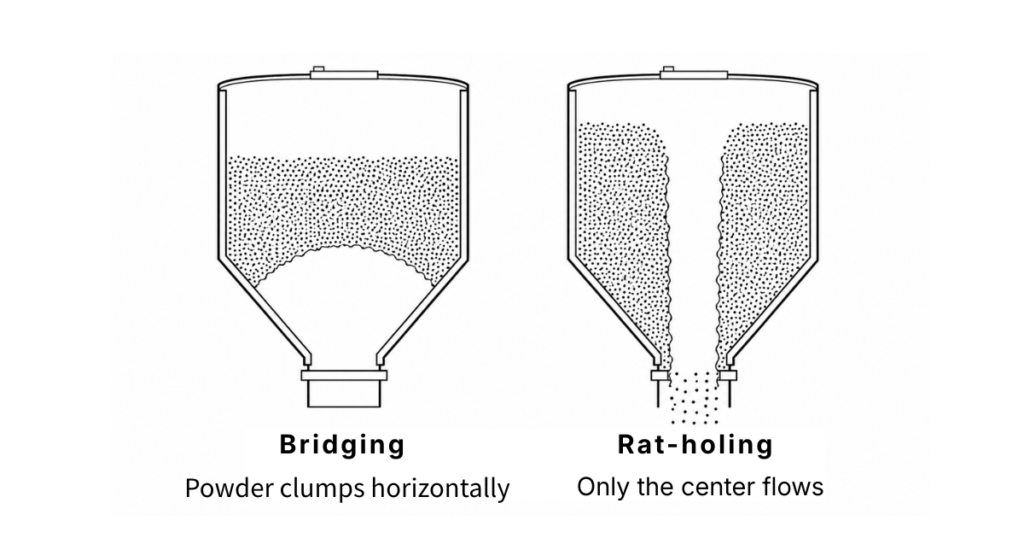
The other problem is that the amount that actually comes out varies. When a powder has poor flow characteristics, you get bridging (particles arching over the outlet and locking) and rat-holing (powder funneling straight down the center while the walls hold powder in place) near the bottom of the hopper. So the right dose never makes it out.
Protein is especially sensitive: particle size and humidity both affect how it flows, so the dose you get can vary by season, by brand, even by flavor.
Four Design Choices That Solve Both
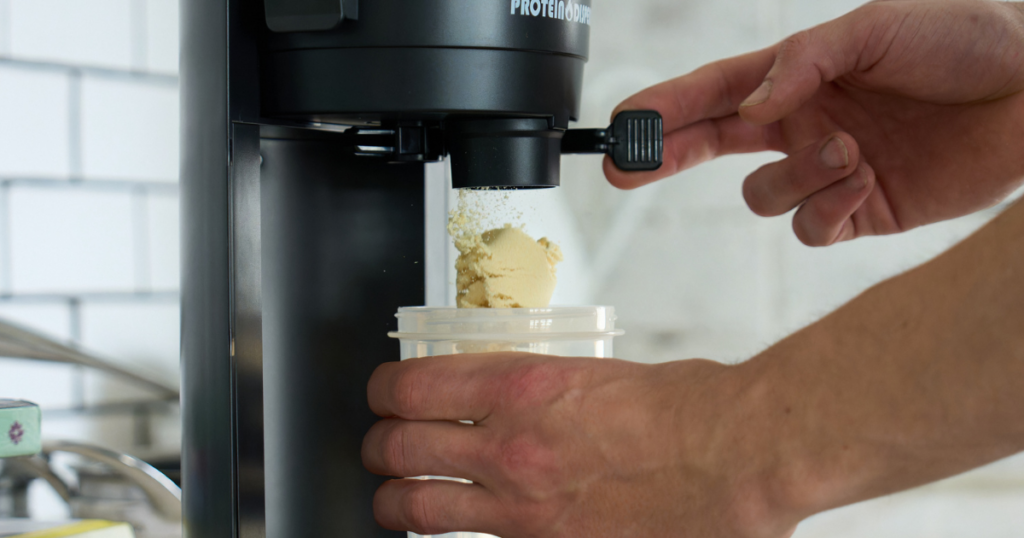
ALENNE addresses both problems with four structural choices. Here’s how each one works, following the path of the powder:
1. An Agitator Stirs the Powder Inside the Hopper
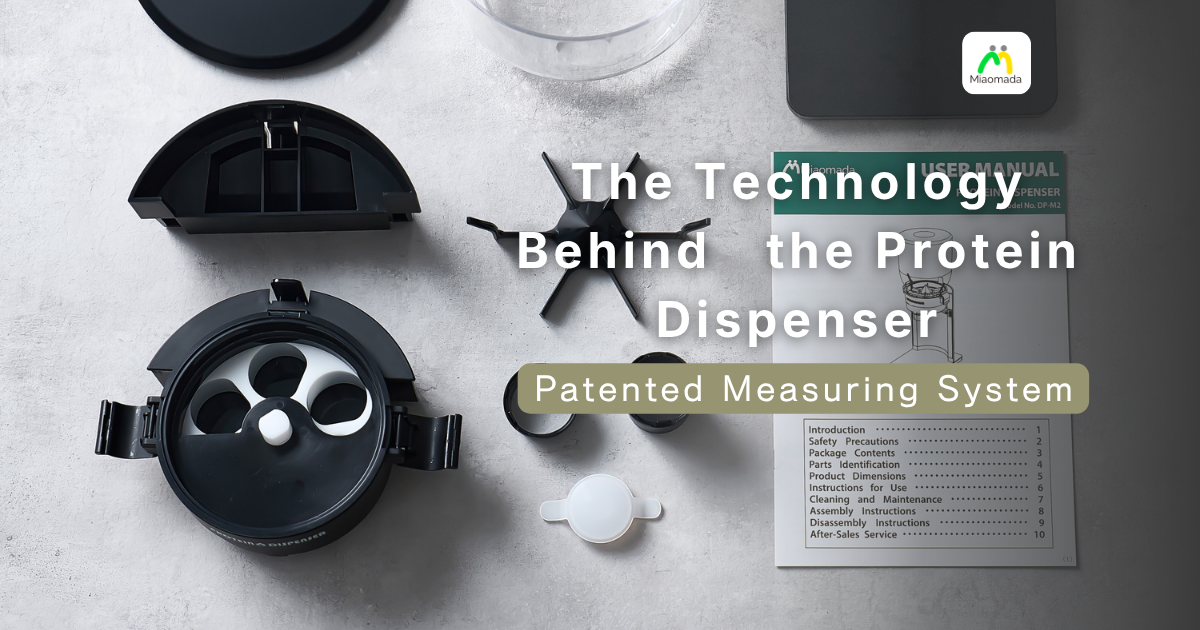
Inside the hopper, an agitator (a set of rotating vanes) is connected to the lever, so each pull rotates it.
Low-flow powders like protein, left alone, settle into uneven pockets and clog near the outlet (the bridging and rat-holing described above). The agitator keeps powder moving, maintains flow at the outlet, and ensures a consistent amount drops into the dosing chambers below.
The vanes come in two types: long vanes that travel close to the hopper walls, and shorter, thicker vanes for stirring force in the center. Finding the right combination took more iteration than expected.
2. A Ring-Shaped Pocket Contains the Powder Path
Directly below the hopper, inside the main housing, sits a ring-shaped cavity that encloses the entire powder path. The space is bounded by an outer wall, an inner wall, and a base.
The only parts that touch the powder during operation move within this ring. Any powder that does leak past the mechanism has nowhere to escape to the outside.
3. A Cover Plate Keeps “Powder Mid-Transit” Under Control
Six small dosing chambers rotate around the ring, each one receiving powder as it passes directly under the hopper, then dropping that powder when it reaches the outlet.
What makes it work cleanly is the cover plate fitted above the ring. It seals any dosing chamber that’s currently transporting powder, and has a single port positioned directly under the hopper so powder falls smoothly into the chamber passing beneath it.
Because of this, powder doesn’t continue feeding into a chamber while it’s still moving, and the loaded amount doesn’t drift between filling and dispensing.
4. A Leveling Edge for Final Precision
At the boundary between the cover and the opening, there’s a dedicated leveling edge (a scraper that scrapes off any excess powder sitting on top of a chamber as it rotates past).
Each lever pull leaves the same volume in the chamber, regardless of how the powder settled on the way in. The result is a consistent dose, every pull.
For more on the design iteration behind this mechanism, see 19 Prototypes to a Dosing Mechanism.
Seven Claims Protect the Whole Design
Japan Patent No. 7580860 is structured around seven claims. In summary:
- Base architecture (case, shaft, dosing chambers, and cover plate, as a system)
- Operating motion (handle and ratchet mechanism)
- The presence of a leveling edge
- Specific geometry of the leveling edge
- Agitator configuration
- Specific geometry of the agitator vanes
- Dosing-chamber bore widening downward
Together, the seven claims protect a structure that doesn’t leak and doses consistently. Imitating one element alone doesn’t reproduce the system. The patent covers the integrated whole.
How It Differs From the Existing US Patent
A US patent already exists for a powder dispensing device. But its mechanism has a known weakness: powder leaks past the moving parts during lever operation and eventually escapes through the lever port.
ALENNE addresses that exact failure mode with the combination of a ring-shaped cavity and a cover plate, an architecturally different approach that was registered in Japan as an independent structure that doesn’t overlap the prior US patent.
US Patent Application Pending
The ALENNE Protein Dispenser was built with the US market in mind from the start. A US patent application was filed in January 2025 and is currently under examination. The goal is to carry the same protections into every market the product enters.
A Mechanism Worth Building Into Your Mornings
If all you want is to escape scooping, a cheap dispenser might be enough. But if you also want no leakage, consistent doses, and a unit that holds up over time, the options narrow quickly.
The ALENNE Protein Dispenser is, as of today, the only protein dispenser with a Japanese-patented dosing mechanism behind it. Years of iteration, a patent, and FDA-compliant materials built into something you use every morning.