Protein Clumps Have 2 Different Causes: Not Dissolving and Caking Are Separate Problems
You shake it properly, and there’s still a white lump sitting at the bottom. The last mouthful catches in your throat, chalky. Almost everyone who drinks protein runs into this at some point.
2 completely different things get filed under the same word. There are the lumps that never dissolve in your shaker, and there’s the powder that goes hard inside the bag. The causes are different, so the fixes are different too. Below I separate the two, then run through the fixes you can try with today’s shake.
The 2 Causes of Protein Clumps
2 things cause protein clumps: how you mix the powder, and how you store it.
Lumps Left in the Shaker: Mixing and Temperature
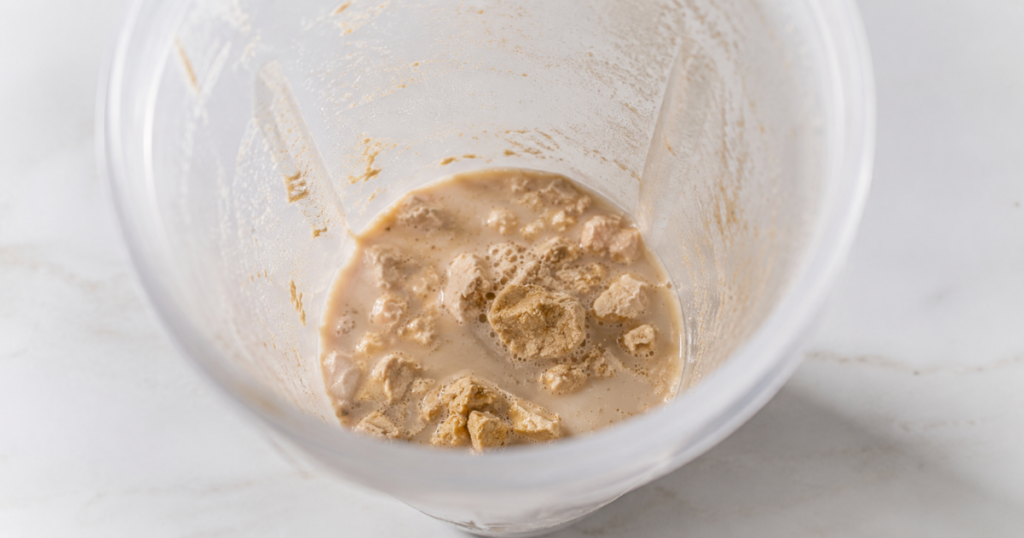
Powder goes into water in 4 stages. It wets, it sinks, it disperses, then it dissolves. The first stage is where it usually fails. The moment protein powder hits the water, the outside can absorb some of it and form a gel skin, and from then on the outside is wet while the inside is still dry powder. That is what a lump in your shaker actually is.
Once a lump is wrapped in that skin, shaking barely breaks it apart. Not letting one form is far easier than fighting it afterwards.
Caking in the Bag or Tub: Humidity
The other kind shows up in a bag you opened a while back, with the powder gone lumpy and hard. That one isn’t about mixing, it’s about storage. When powder is exposed to moisture in the air, water bridges form between the particles and they stick to each other, a process known as caking.
So the lumps in your shaker come from mixing and temperature, and the lumps in your bag come from humidity. Each has its own fix.
5 Ways to Stop Lumps in the Shaker
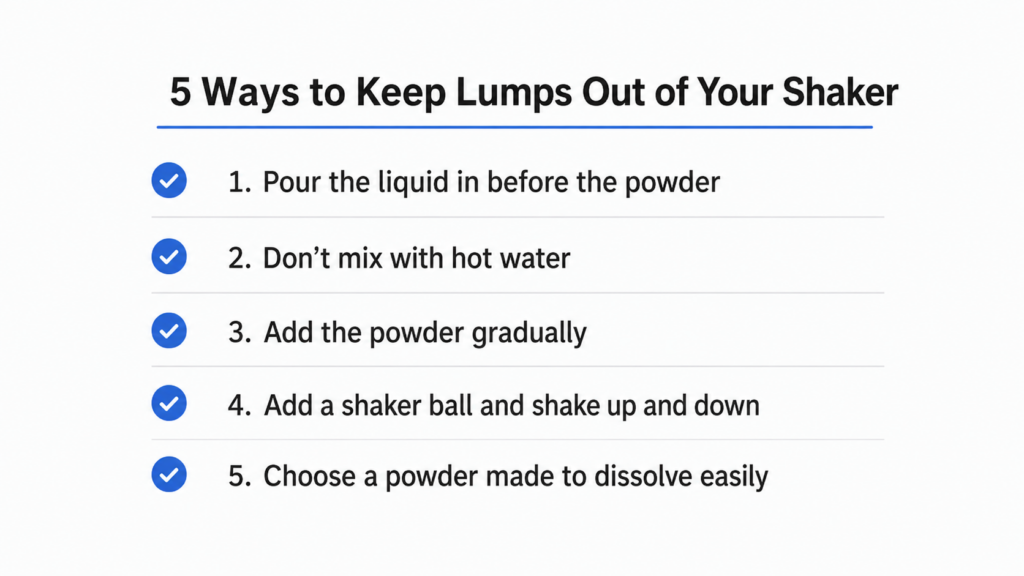
1. Liquid First, Powder Second
The order you pour is the simplest change and the most effective. Powder that goes in first sticks to the bottom and the walls, soaks up water there, and turns into a layer that won’t break up. Put the water or milk in first and add the powder on top, and it disperses across the surface instead.
2. Don’t Mix It With Hot Water
Whey protein denatures above roughly 65°C (149°F) and sets more readily. If you pour boiling water on it, the surface can coagulate all at once, sealing a lump inside a paste-like shell. Even when you want it warm, steer clear of water that hot.
3. Don’t Tip It All In at Once
The gel skin forms easily when a whole serving goes in at once. When you have a moment, add half, shake it lightly, then add the rest, and you’ll get far fewer lumps.
4. Add a Shaker Ball and Shake Up and Down
A stainless mixing ball or a spring whisk physically breaks up lumps as they form. Shake up and down rather than side to side, for about 30 seconds, which is what most shaker manufacturers recommend.
5. Choose a Powder Made to Dissolve
Some whey is instantized, treated with lecithin (an emulsifier) so the powder wets faster. In one study, untreated whey protein concentrate (WPC) needed more than 90 shakes to disperse, while the instantized powder was done in 15 to 42. If nothing you try gets a particular powder to dissolve, changing the product itself is a fair move.
Casein and soy do tend to dissolve less readily than whey, though processing changes that too.
Caking in the Bag Is a Storage Problem
Caking comes from moisture, so the fix is cutting how much moisture the powder is exposed to. Close the bag properly after every use, and keep it out of humid spots, near a bathroom or beside the stove. For how to think about storage conditions, see What Actually Matters in Protein Storage Wasn’t “Sealing It Tight”.
What about powder that has already gone hard? Caking on its own isn’t understood to turn the contents into something else, but it’s a clear sign the powder has drawn in moisture. If there is an off smell, a change in color, or obvious water damage, leave it rather than pushing through it. For how to tell, see Protein Powder Shelf Life and the Signs It’s Gone Off.
While You’re At It, Look at the Measuring
Those five will prevent most of the lumps in your shaker. The other friction that comes back every day is measuring. Every scoop out of the bag throws powder around, and the amount in a level scoop varies a little each time. A tool can take care of that part.
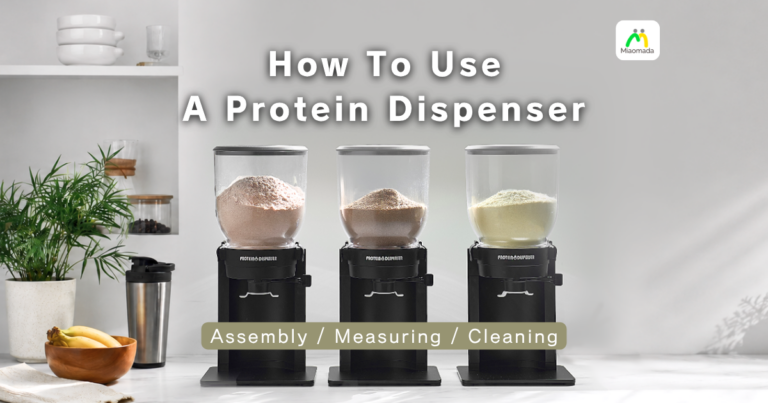
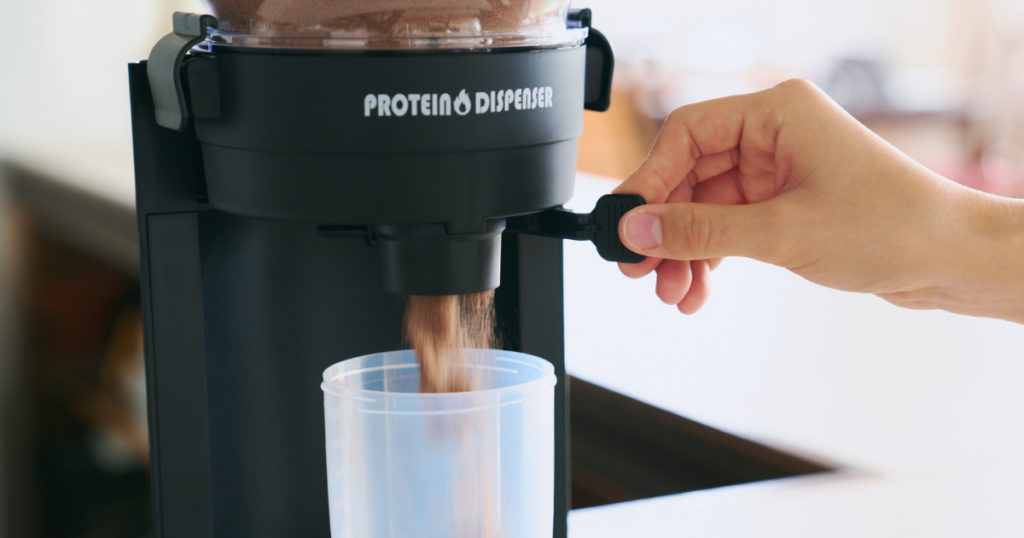
The ALENNE Protein Dispenser we build at Miaomada holds the powder in the unit, and one pull of the lever measures roughly 10 to 15 g straight into your shaker. Your hands never touch the powder when you refill it or when you use it, and it takes care of the spilling too. On the morning measuring grind, there’s more in If Measuring Protein Feels Like a Hassle.
In Summary: The Answer Is Not Letting Lumps Form
- Lumps in the shaker and lumps in the bag have separate causes. Mixing and temperature for one, humidity for the other
- Liquid first, powder second. Skip the hot water, and shake up and down for 30 seconds
- If a powder keeps refusing to dissolve, switching to an instantized product is an option
- A caked bag is a humidity signal. Start with how you close it and where you keep it
All of it works from today’s shake onward. Take the small frictions out, and keeping the habit up gets a lot easier.
The ALENNE Protein Dispenser
The ALENNE Protein Dispenser is Miaomada’s flagship product: pour straight from the bag or tub into the hopper, slide the lever to measure a set dose, and keep it on the counter as part of your daily routine.
Lumps are one small friction. Scooping and spilling are two more. If you’re clearing them out one by one, this is the next to come off the list.

![What Is a Protein Dispenser? How It Works and Why It Matters [Complete Guide]](https://en.miaomada.co.jp/wp-content/uploads/2026/05/What-Is-a-Protein-Dispenser-768x403.png)

![Inside Two Successful Makuake Crowdfunding Campaigns [Part 2]: DP-M2, Building for the World](https://en.miaomada.co.jp/wp-content/uploads/2026/04/260428_008_part2_en-768x403.png)