
Scoop vs Dispenser: How Protein Measuring Actually Differs
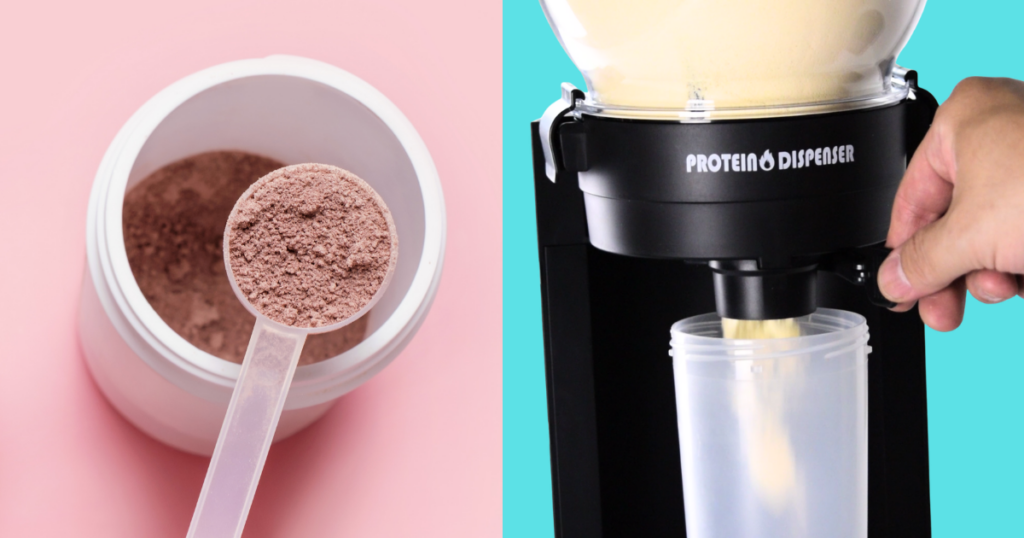
Most people who drink protein measure with the scoop that came in the bag. It’s already there, it costs nothing extra, and there’s no obvious reason to question it.
I used to do the same thing. For nearly three years I scooped my protein every morning and assumed that was just how it worked.
Then I started using (and eventually designing) a protein dispenser, and it became obvious that scoop measuring and dispenser measuring are not the same thing. They differ in accuracy, in hygiene, in how easy the habit is to sustain. It’s not just “more convenient.”
This article compares the two methods across seven points. I’m not arguing one is universally better. They each fit different lifestyles, and the goal is to help you pick the one that fits yours better.
1. Measuring Accuracy
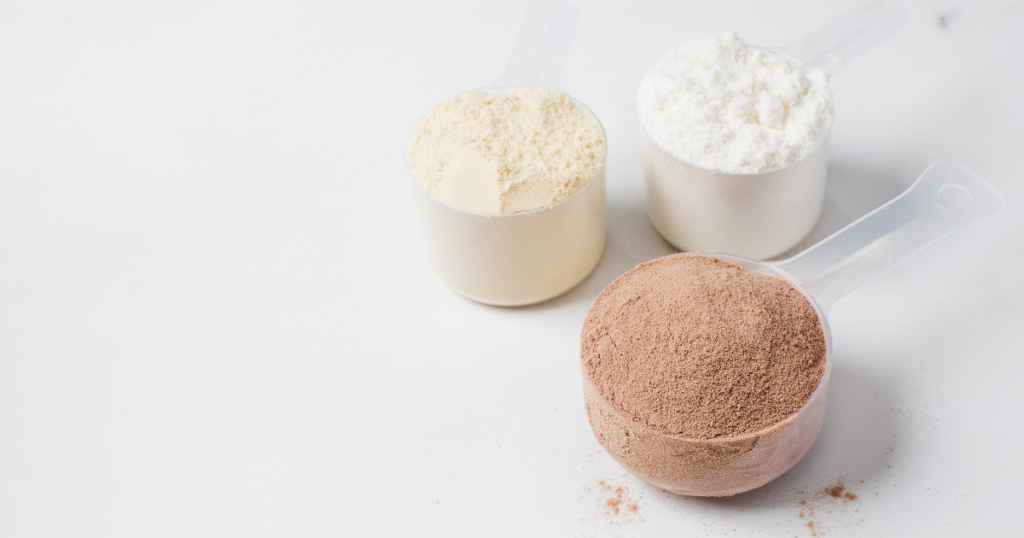
Scoop measuring varies more than people realize.
Even when you carefully level the scoop, the way you dig into the powder and how packed it is, the dose can be off by roughly ±20%. Heaped scoops swing it further. When a brand prints “X grams per scoop” on the bag, that number assumes an ideal level scoop, not a real one.
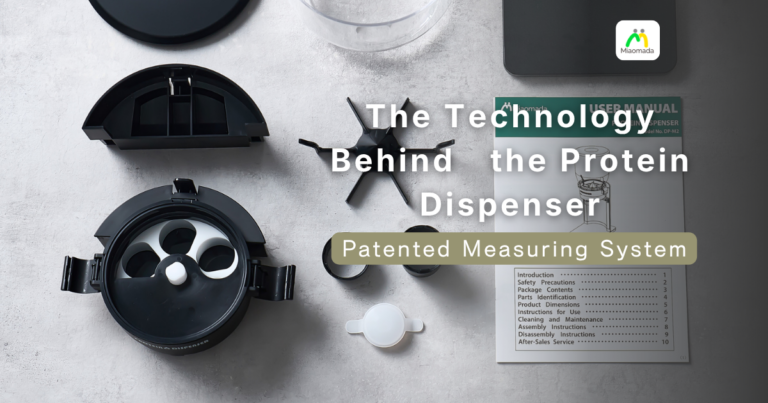
A dispenser runs the same mechanical motion every time, so the dose variation drops sharply. The ALENNE Protein Dispenser was validated for dose consistency in a 25,000 cycle endurance test, using a patented rotating dosing chamber (Japan Patent No. 7580860) that cuts off the same volume of powder per pull. Variation between protein types and flavors still exists, but the deciding question is: does the dose depend on your hand? With a dispenser, it doesn’t.
2. Time
Have you ever timed your scoop routine?
Pull the bag out → open the zip or lid → find the scoop → dig in → level it off → transfer to the shaker → wipe up spilled powder → reseal the zip or lid → put the bag back. About ten steps. Even a practiced user spends 40 to 60 seconds on it.
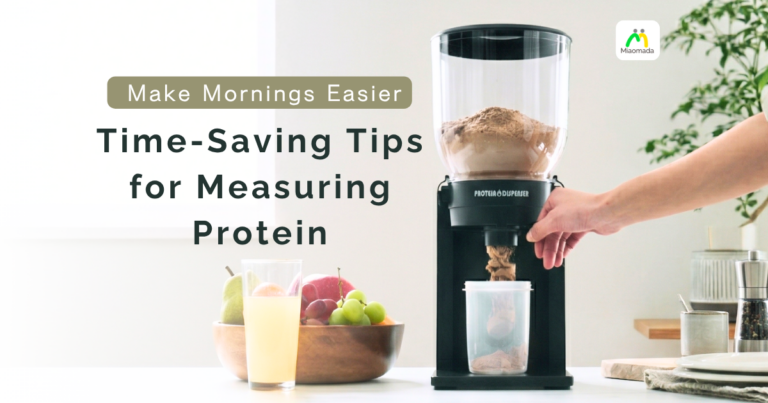
A dispenser is: place the shaker under it, pull the lever. Done in under 10 seconds.
A 50 second difference per day sounds trivial, but multiplied across 365 mornings, it adds up to roughly five hours a year. And on a rushed weekday morning, those 50 seconds feel like more.
3. Spilling and Powder Scatter
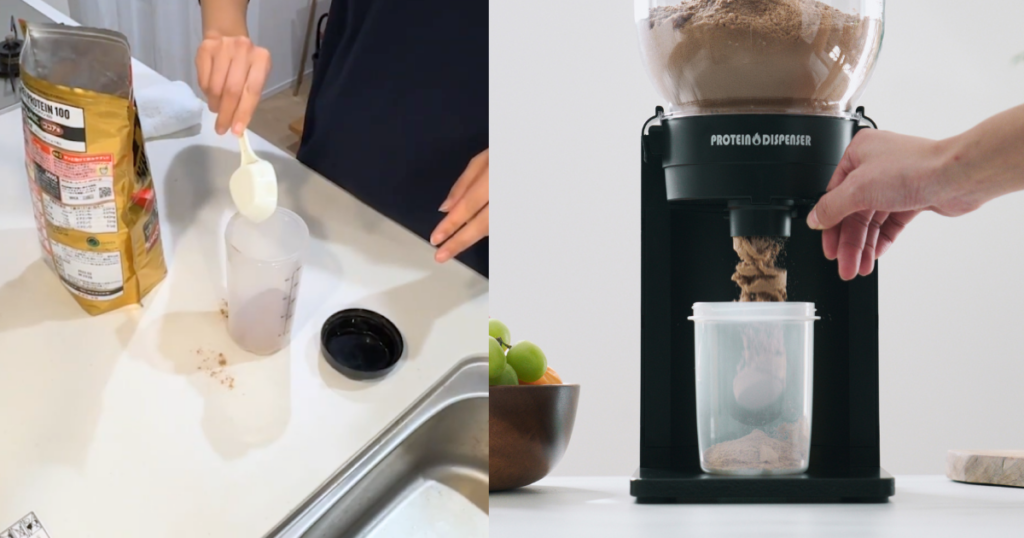
I doubt there’s a single scoop user who has never spilled protein.
Three moments create scatter risk: lifting the scoop out of the bag, leveling it off, and transferring it into the shaker. Fine-particle powders like WPI and soy go airborne especially easily. For some people, wiping the kitchen counter has become part of their daily routine.
A dispenser drops powder directly from the nozzle into the shaker, the path is enclosed. The ALENNE nozzle is shaped to reduce scatter, and the dispensing event itself has almost no exposure point. Not zero, but far less than a scoop.
For more on why protein spills and what to do about it, see The Protein Spill Problem: Let’s End It.
4. Hygiene
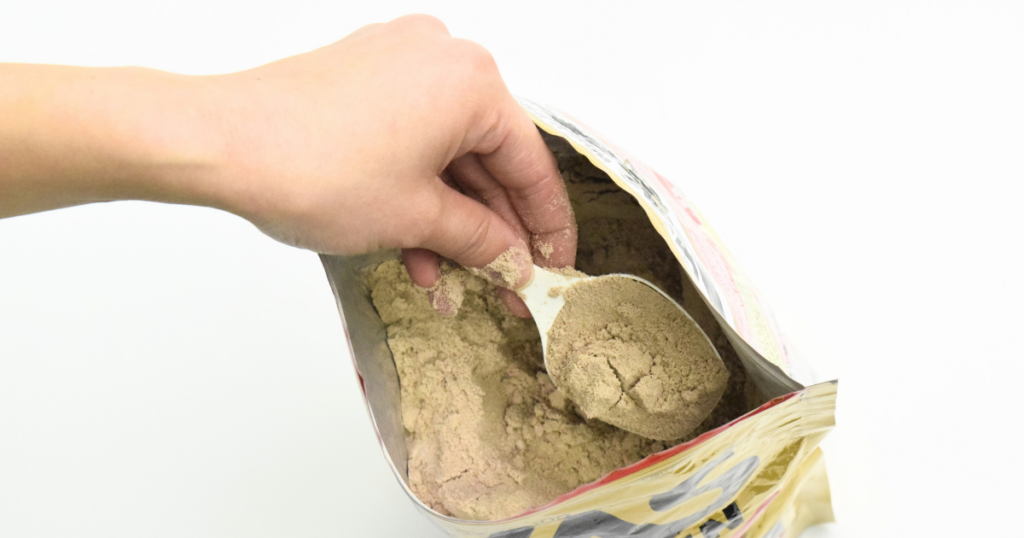
Scoop measuring tends to put your hands in direct contact with the powder. You reach into the bag or tub for the scoop, your fingers touch the powder when leveling, and you brush spilled powder off with your hand. Each time, skin oils and a bit of moisture transfer into the powder, accelerating degradation and creating better conditions for microbial growth.
With a dispenser, your hands never touch the powder. Pour straight from the bag or tub into the hopper, then slide the lever to measure. The powder goes from the ALENNE Protein Dispenser to the shaker, no contact needed.
For more on protein storage, see What Really Matters for Protein Storage Isn’t “Airtight”.
5. One-Handed Operation
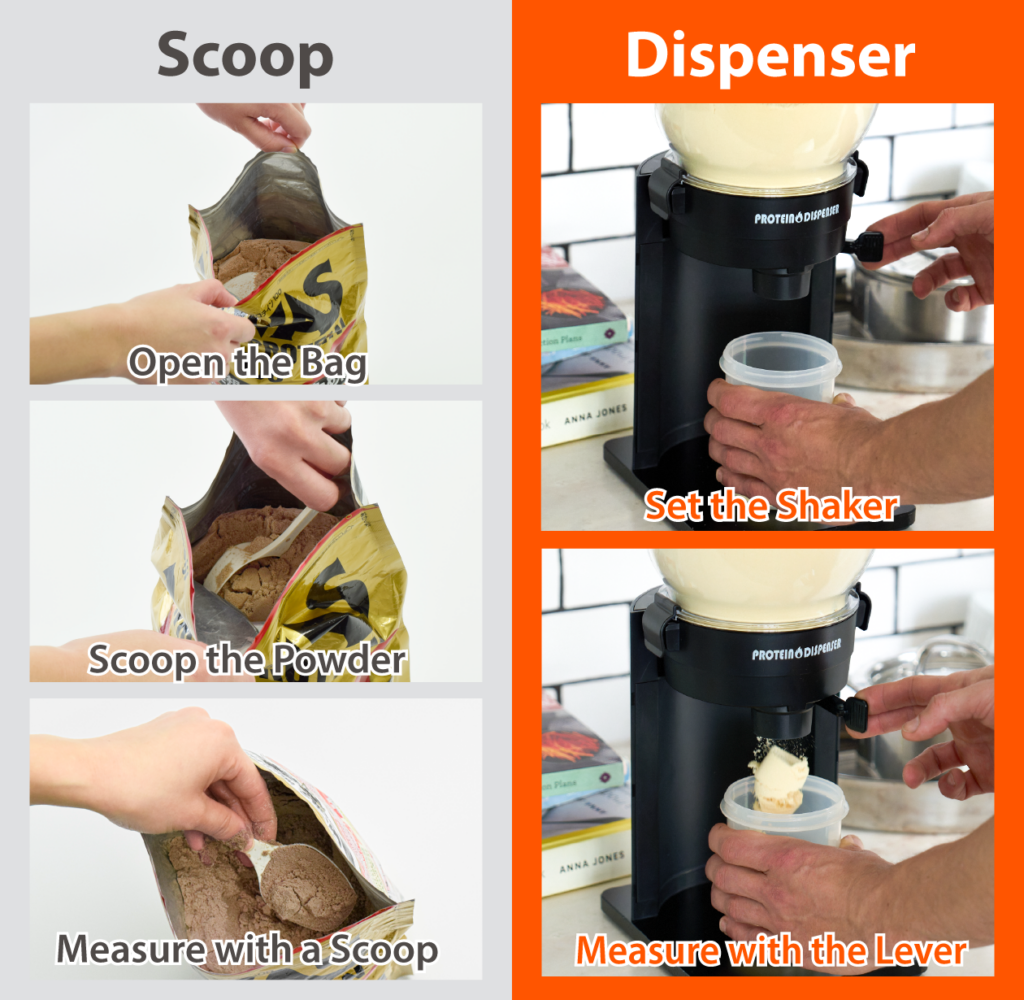
Scoop measuring is essentially a two-handed job. One hand steadies the bag or tub, the other handles the scoop. Hard to manage when you’re also brewing coffee.
A dispenser is a one-handed job: set the shaker down, pull the lever. Your other hand is free for whatever else needs your attention.
It sounds minor, but worked into a busy morning, it matters more than you’d think.
6. Cost
This is where scoop measuring wins.
The scoop comes free with the protein, so the marginal cost is zero. A dispenser like the ALENNE sells for ¥22,800 in Japan (around US$150).
That said, it’s a one-time purchase that lasts a long time. Treat it like a coffee maker or a blender, a daily appliance, and the cost spreads out to cents a day across a few years of use. Whether that’s worth it depends on how much you value a tool you use every day.
If you’re considering switching from powder to ready-to-drink protein shakes or bars, the gap runs from US$20 to $40 per month. At that rate, a dispenser pays for itself in 4 to 8 months.
7. Sticking With It — “Same Amount Every Day” Matters More Than Precision
This is the point I most want to make.
You’ve probably seen the ‘2 grams of protein per kg of body weight’ guideline, but that’s actually a target for people training hard. For sedentary adults the recommendation is closer to 0.8 g/kg, and for people who exercise regularly, somewhere between 1.2 and 1.7 g/kg (numbers vary by source; for specific cases or more detailed guidance, talk to a professional).
One thing that often gets missed: those numbers refer to grams of protein, not grams of powder. Within the same brand and product line, different flavors can have different protein content per serving. “X scoops = the protein I need” doesn’t actually hold.
Should you check the nutrition label and calculate it precisely every time? If you’re tracking macros seriously, absolutely. But for most people, what matters more is taking a consistent amount, every day. A habit that holds beats a perfect dose that doesn’t.
By that standard, scoop measuring drifts because the human hand drifts. A dispenser locks in the same motion, so “today’s dose is the same as yesterday’s” comes naturally.
Protein only works if you keep taking it. But the chore of measuring can be enough to derail the habit. The higher the friction, the more “I’ll skip today” creeps in. When the routine starts to feel like a chore, that’s when the habit starts to break.
Summary: The 7-Point Comparison
| Dimension | Scoop | Dispenser |
|---|---|---|
| Accuracy | Roughly ±20% (depends on hand) | Consistent mechanical motion |
| Time per use | 40–60 seconds | About 10 seconds |
| Spill risk | Three exposure points | Largely contained by nozzle |
| Hygiene | Hand often touches powder | No contact needed |
| One-handed | No (two hands required) | Yes |
| Cost | Zero | Upfront purchase |
| Sticking with it | Depends on the person | Low friction, easy to keep up |
Scoop measuring is simple and free. But dispenser measuring wins on accuracy, hygiene, and time saved.
Neither is universally right. Pick based on what you actually value. If “I don’t have time to waste,” “I’m tired of spills,” or “I want a consistent dose” resonates with you, a dispenser is worth a serious look.
For the full picture of what a protein dispenser is and how it works, see What Is a Protein Dispenser? How It Works and Why It Matters. For the engineering behind the patented dosing mechanism, see 19 Prototypes to a Dosing Mechanism.
The ALENNE Protein Dispenser is a Japan-made dispenser built around a patented dosing mechanism. One lever pull dispenses a measured serving, with storage for up to 1 kg of powder. The nozzle is shaped to reduce scatter, and it disassembles for cleaning without any tools.

![Inside Two Successful Makuake Crowdfunding Campaigns [Part 1] — DP-M1, Setting Off From Zero Recognition](https://en.miaomada.co.jp/wp-content/uploads/2026/04/260424_008_part1_en-768x403.png)