What Is a Protein Dispenser? How It Works and Why It Matters [Complete Guide]
I drink protein every morning. I’ve kept it up for over two years now.
For most of that time, I measured with a scoop, and honestly, that part of the routine always bothered me. Reaching into the bag to fish out the scoop. Dumping it into the shaker. Powder spilling. Hands covered in it. Every single morning, 365 days a year.
Drinking protein had become a habit, but the prep work never stopped feeling like a chore. That’s what eventually led me to a protein dispenser.
In this article, I want to lay out what a protein dispenser is, how it works, and what actually changes when you start using one. I’ll also share what I’ve noticed as a daily user.
What Is a Protein Dispenser?

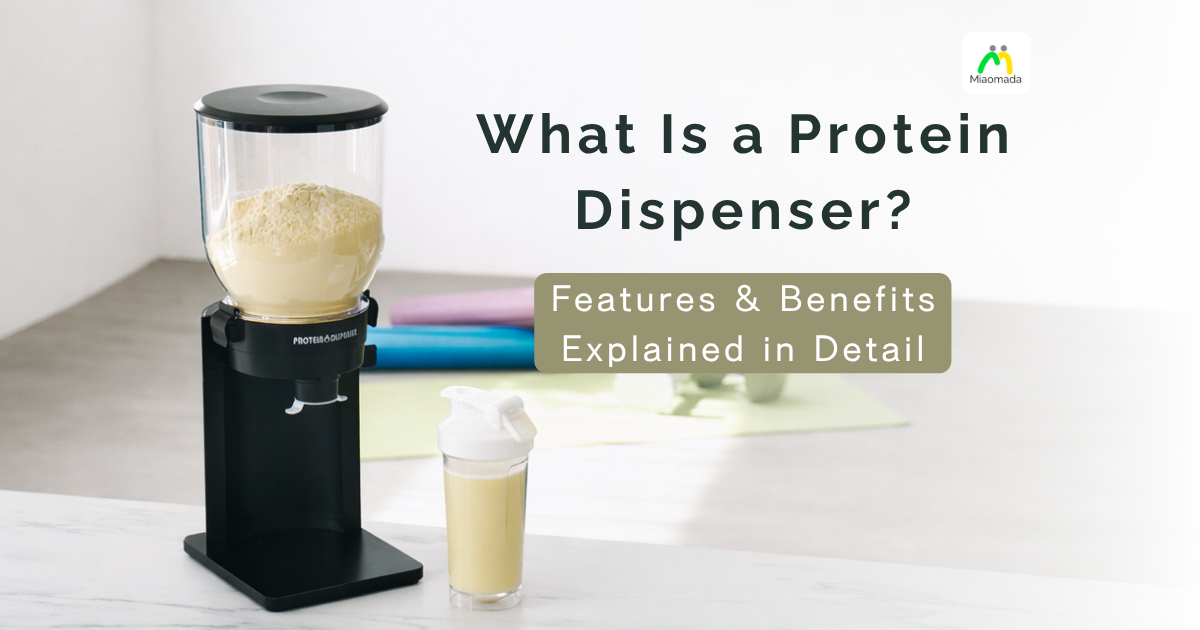
A protein dispenser is a device that handles both storage and measuring of powder in a single unit. You load the powder in, pull a lever, and the right amount comes out. That’s the whole idea.
But that “whole idea” turns out to be a bigger deal than it sounds.
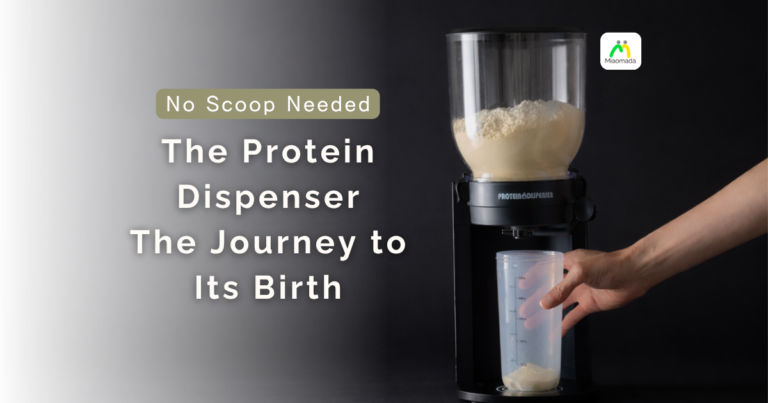
The traditional way to take protein is a three-step process: open the bag, scoop the powder, transfer it to your shaker. With a dispenser, it collapses to two actions: pull the lever, powder falls into the shaker. You can do it one-handed, and the whole thing takes about five seconds, which really matters on a busy morning.
The Japanese protein market hit roughly ¥129 billion in 2024, and the user base has expanded well beyond athletes: women drinking it for skin and beauty reasons, older adults using it for general health. Protein has shifted from “something special” to “an everyday habit.” That’s exactly why tools that reduce the friction around measuring and storage are getting attention.
What Actually Changes When You Switch
Here’s what I noticed firsthand after going from a scoop to a dispenser.
No more spilled powder
When you scoop powder and transfer it to a shaker, some always escapes into the air. A dispenser drops the powder straight from the nozzle into the shaker, so that scattering basically disappears. I went from wiping the kitchen counter every morning to barely thinking about it. It sounds minor, but it might be the change I appreciate the most.
I’ve written more about why protein spills happen and what to do about it in The Protein Spill Problem: Let’s End It.
My hands stay clean
You stop reaching into the bag to fish out a scoop. It’s more hygienic, and it’s a real plus for anyone with manicured nails. For me, the appeal was simpler: I no longer have to wash powder off my hands every morning before doing anything else.
Measuring becomes consistent
A scoop “leveled off” by hand actually varies a lot. Measure it precisely and you’ll see swings of 10 to 20 percent. A dispenser controls the amount mechanically, and each lever pull lands within about a gram of the last one. If you’re tracking macros seriously, that consistency makes a real difference.
The kitchen gets tidier
Bag, scoop, clip, separate storage container. The protein-related clutter adds up. A dispenser handles storage and measuring in one unit, and my kitchen counter looks meaningfully cleaner because of it.
Prep takes way less time
Scooping used to take me 30 to 60 seconds. Now it’s two or three lever pulls, about five seconds. A trivial difference on any given morning, but multiplied across a year, it’s more than five hours saved.
What Sets the ALENNE Protein Dispenser Apart
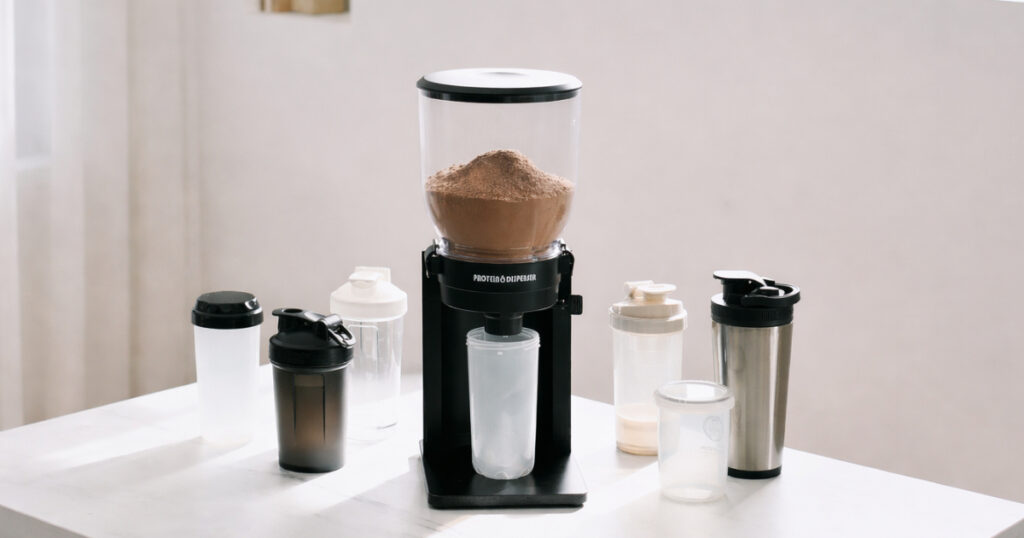
Honestly, “protein dispenser” is still a young category. As of now, our ALENNE Protein Dispenser is essentially the only product in it. So instead of a how-to-choose guide, here’s the design thinking behind ours.
A patented dosing mechanism
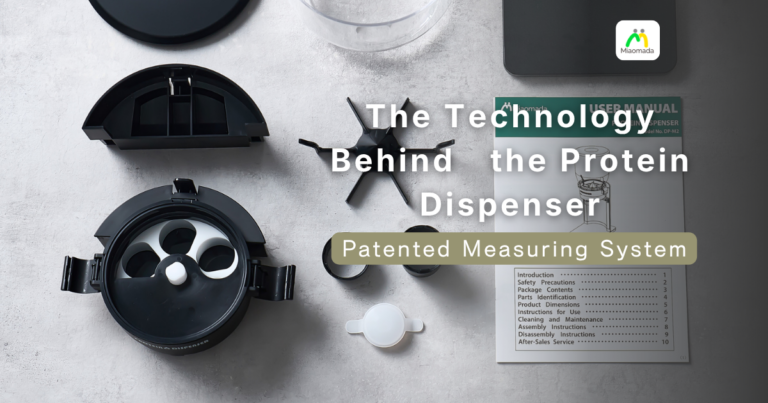
Whey, soy, casein; the density of protein powders varies more than people realize. ALENNE uses a dosing mechanism designed to stay consistent across powder types, and it’s patented (Japan Patent No. 7580860). Each lever pull stays within a gram of the previous one.
A full kilogram of storage
The hopper holds about 1 kg. Refill it once when you open a new bag, and you’re set for roughly a month. The less often you refill, the less it interrupts your routine.
Tool-free disassembly for cleaning
Powder devices need cleaning, full stop. ALENNE breaks down by hand (no tools required), and every part is washable. If cleaning is a hassle, you stop doing it. We spent real time on this part of the design.
Footprint
The unit is roughly 16 cm wide, 18 cm deep, and 45 cm tall. Since it lives on your kitchen counter, plan for an area of about 20 × 40 cm to leave room for the shaker.
Who It’s For
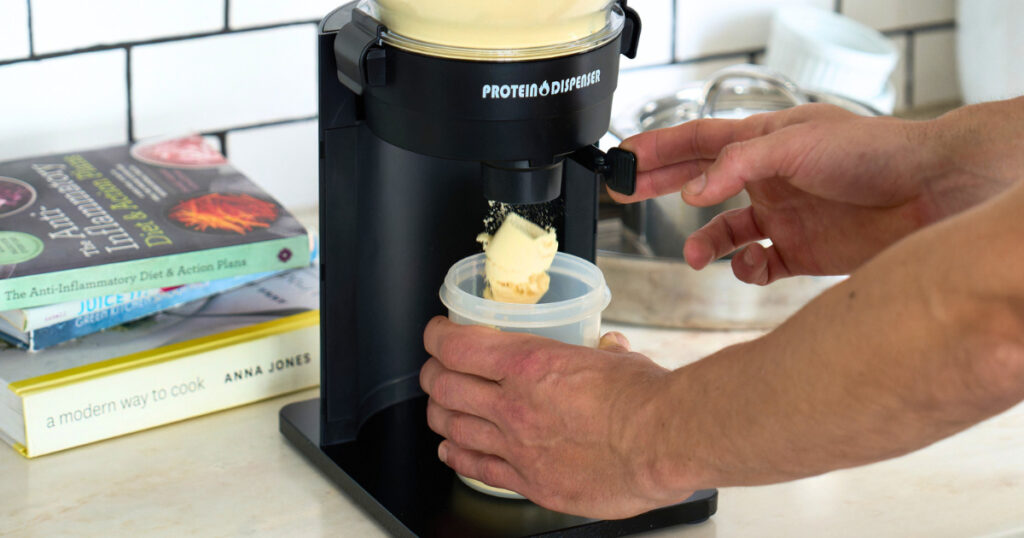
Looking at the people around me who use one, or who’ve expressed interest, here’s who I think benefits most.
People new to lifting. You don’t need to know the “right” way to scoop; just pull the lever. Lower entry barrier to actually sticking with protein.
Busy professionals. One hand, five seconds. Cutting a minute off your morning routine sounds small, but it changes how the rest of the morning feels.
People drinking protein for health or beauty. Clean hands, no mess, and a design that fits in the kitchen. The daily ritual becomes something you don’t dread.
Personal trainers. Putting one in a gym or studio improves the experience for clients and signals attention to detail.
Frequently Asked Questions
The questions I hear most often.
Q. Does it work with any protein powder?
It handles the major types (whey, soy, casein). Very fine powders that stay airborne can scatter slightly when leaving the nozzle, but you can mostly avoid that by inserting the long nozzle into the shaker opening.
Q. How often does it need cleaning?
Once a month is fine for a full disassembly. It comes apart without tools, so it’s a quick job. One thing to keep in mind: use any powder you’ve loaded within a month. If you don’t drink that fast, just load less to start.
Q. How much more accurate is it than a scoop?
A scoop varies by 10–20%. A dispenser stays within a gram per pull. With the same protein, you get effectively the same amount every time.
Q. How much comes out per pull?
It depends on the powder, but typically 10–15 g per pull. Once you figure out how many pulls match your target dose, you just remember the count. Measuring stops being something you have to think about and becomes muscle memory.
Q. Can I use it for things other than protein?
The current design is protein-specific. We don’t recommend it for very fine powders like BCAA or creatine; they scatter too much. Down the road, we’re working on versions that handle other powders, including spices and powdered greens.
Q. How much counter space does it need?
About 16 × 18 × 45 cm. Built to hold a kilo of powder, so it might feel larger than expected. It weighs around 5 kg, which is intentional; it stays put when you pull the lever. Counting the shaker space, plan on roughly 20 × 40 cm.
What I Notice After Quitting the Scoop
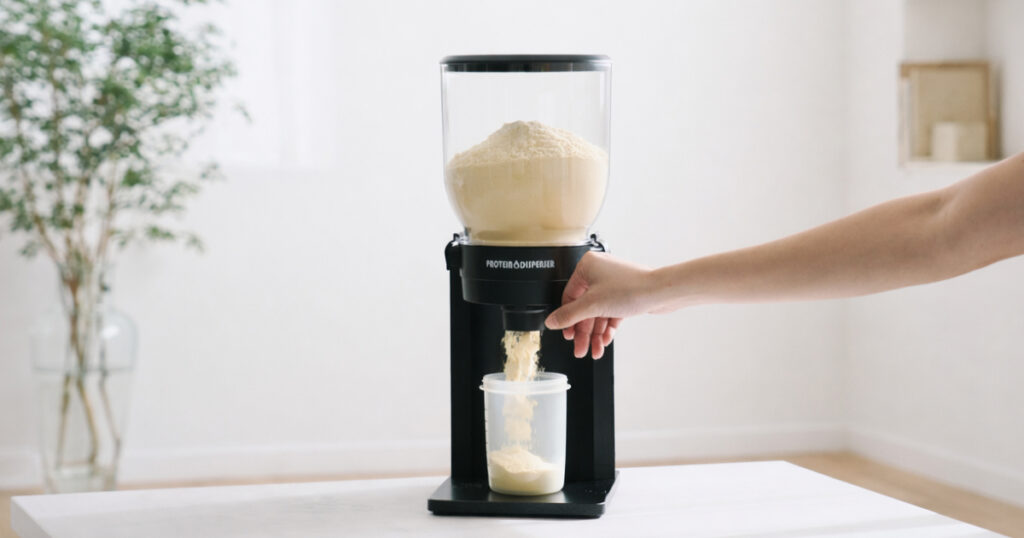
A protein dispenser isn’t a flashy product. It doesn’t promise dramatic results.
But once the daily friction disappears (spilled powder, dirty hands, inconsistent doses), sticking with protein gets noticeably easier. For me, prep went from “annoying chore” to “just part of the morning.”
The things you do every day are exactly where small improvements pay off. That’s what I’ve come to believe.
The ALENNE Protein Dispenser is a Japan-made dispenser built around a patented dosing mechanism. Pull the lever, get an accurate dose. Holds up to 1 kg of powder. Tool-free disassembly for cleaning. Worth a look if any of this sounds like it would help your morning.
![Inside Two Successful Makuake Crowdfunding Campaigns [Part 2]: DP-M2, Building for the World](https://en.miaomada.co.jp/wp-content/uploads/2026/04/260428_008_part2_en-768x403.png)