19 Prototypes to a Dosing Mechanism — The Engineering Behind the Protein Dispenser
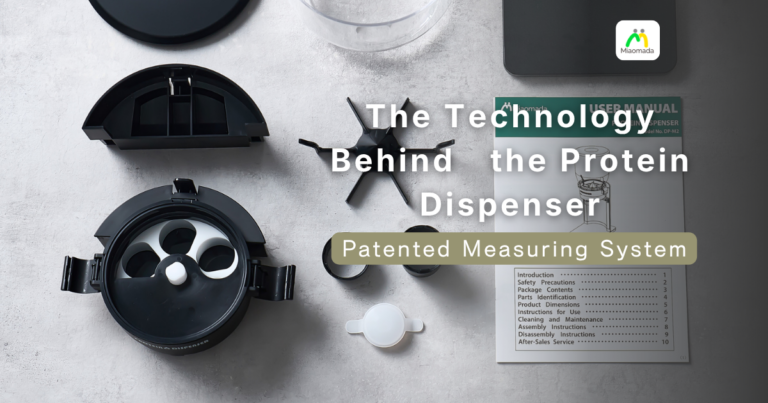
The heart of a protein dispenser is its dosing mechanism. “Pull a lever, get a measured dose of powder.” The sentence is simple. Getting it to actually work, consistently, took 19 prototype revisions, REV0 through REV18.
That mechanism, by the way, came directly out of the failed motorization attempt described in Development Story Part 2. The 360-degree rotation we built for the motor, repurposed as a manual mechanism. That flash of insight is the starting point of this story.
Why “Measuring Powder” Is Hard
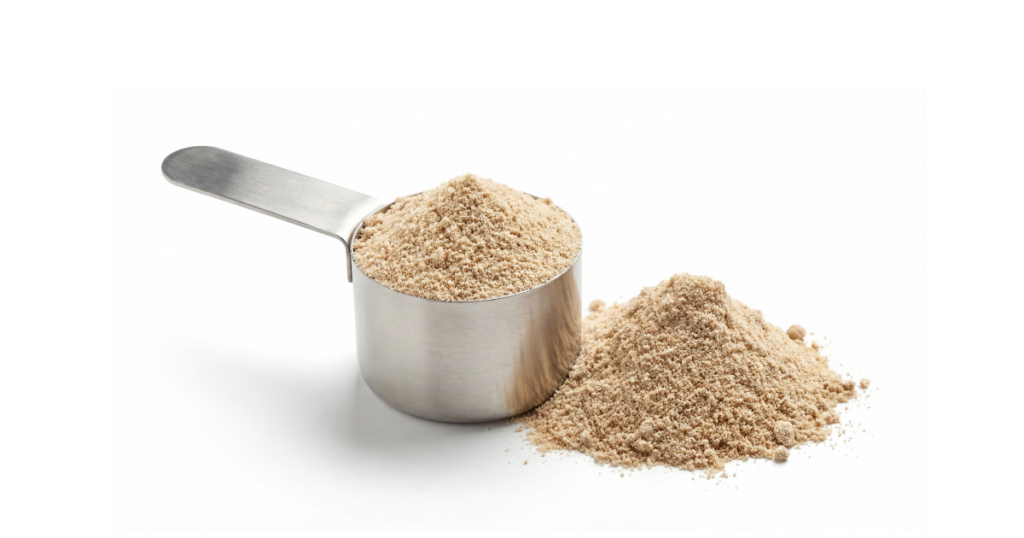
Liquids are easy: pour them and read the volume. Solids are easy: weigh them. Protein powder is neither. It’s a bulk solid, with quirks the other two don’t have.
Bridging. Particles arch over the outlet and lock in place. Same physics as sand stalling in an hourglass, but protein particles are less uniform than sand, so it happens far more often.
Rat-holing. Powder funnels straight down the center while the walls hold residual powder in place. The container looks emptier than it actually is, and dose accuracy drifts further off with every pull.
If you’ve ever tried to dispense protein from a generic cereal dispenser or a spice container, you’ve seen one of two outcomes: it clogs, or it pours too fast. That’s exactly why a protein-specific mechanism was necessary.
The Starting Point: A Failed Motor and the US Wall
Our existing domestic product (DP-M1) used a side-to-side pendulum lever to dose. That architecture was effective in Japan, but blocked from the US — a prior US patent stood in the way.
Trying to motorize the dispenser was the next move. The full story is in Development Story Part 2, but the short version: we tried a 360-degree rotating dosing chamber driven by a motor, and abandoned it because of motor cost and control complexity.
What survived was the idea, the rotation itself. Replace the motor with a manual ratchet lever, and the same chamber rotates over a small angle of motion. Distinct from the prior US patent, free of the pendulum’s structural constraints. We ran patentability searches in both Japan and the US, confirmed no infringement, and started a clean-slate redesign.
That kicked off the 19-prototype journey.
REV0 to REV3: From Concept to Bridging Reality
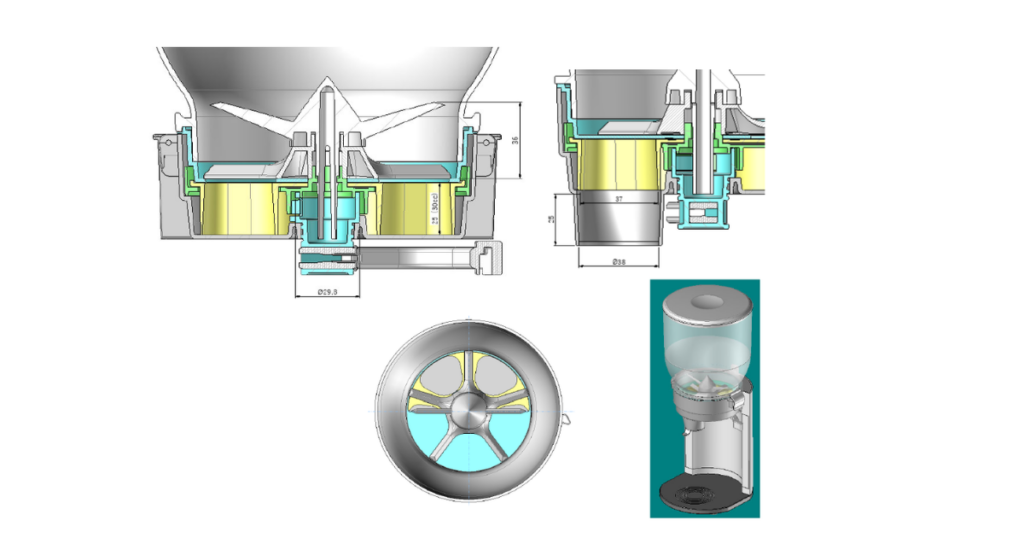
REV0 was the conceptual layout, the first physical mockup of what had been a sketch.
REV1 moved the snap-fit features to a separate part to make assembly viable. REV2 revisited the rotation direction and the geometry of the hopper opening.
Then REV3 hit the first wall. Protein in the hopper bridged and stopped flowing. The rotation mechanism slipped, snap-fit play caused it to spin without engaging. We learned, the hard way, that powder behavior and mechanical precision had to be solved simultaneously, not sequentially.
REV4 to REV11: Eight Rounds Trying to Make Powder Fall Reliably
Eight straight revisions, all on the same theme:
Get the powder to fall into the dosing chamber consistently.
Same volume, same timing, every pull. That single requirement refused to stabilize. Change protein brands and the behavior changed. Change particle size and it clogged. Change humidity and the flow rate moved.
REV4 through REV11 (eight consecutive prototypes) each varied the agitator shape, the shutter geometry, the chamber count and arrangement.
In the middle of that stretch, REV9 also improved lever feel. Tactile refinement happened in parallel with the powder-flow work.
This was the longest and hardest stretch of the entire program. “Design → mockup → test → root-cause analysis” eight times, until powder finally fell the way it was supposed to.
REV12 to REV15: Building In Usability and Durability
Once flow was consistent, attention shifted to the user side.
REV12 and REV13 added a self-returning lever mechanism, anti-misassembly features, and an extended nozzle to further suppress scatter.
REV14 switched the connecting shaft to machined POM (polyacetal), chosen for mechanical strength and low-friction sliding properties, to extend moving-part life.
REV15 finalized the rotation direction, reshaped both the lever and the dosing chamber, and reinforced the area around the connecting shaft.
REV16 to REV18: Final Polish
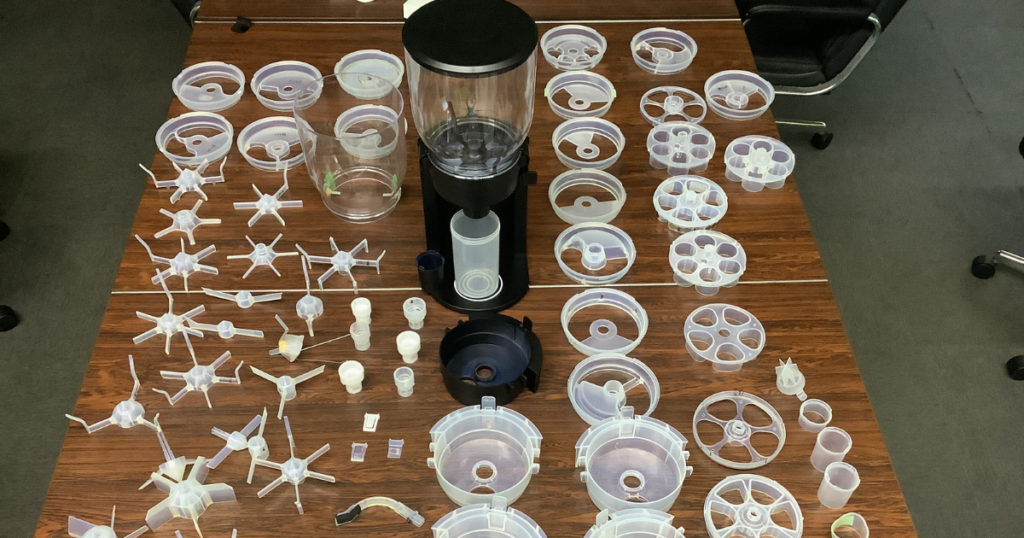
REV16 added the nozzle and cap, and finalized the contact surfaces between the body and connecting shaft. REV17 ran design verification in parallel with three more refinements: stopping micro-scale powder leakage from the nozzle, hardening the anti-misassembly features, and fine-tuning the contact surfaces.
REV18 adjusted the spring-insertion shaft height. That was the last revision and the configuration that went to mass production.
25,000-Cycle Endurance Testing — Built to Last Five Years
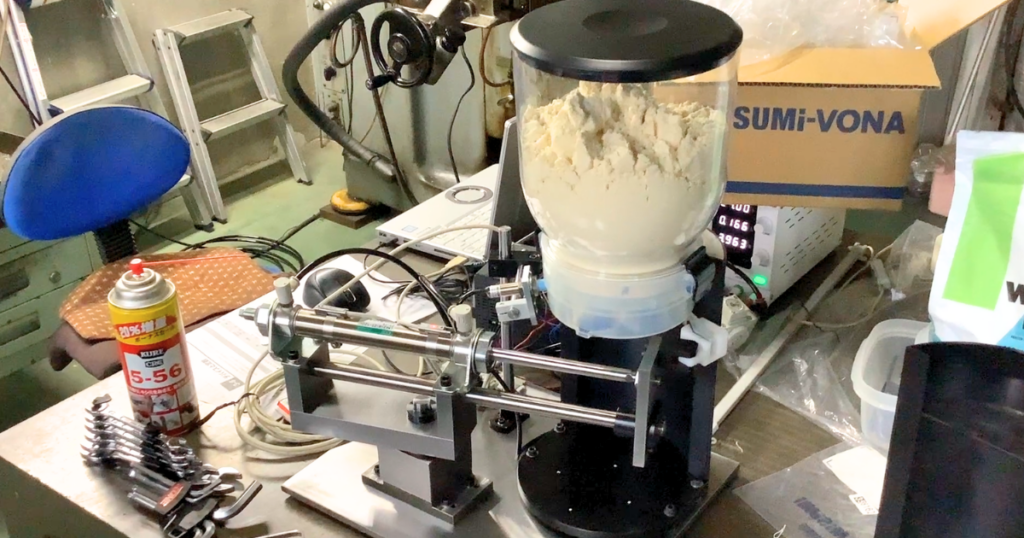
Once the design was locked, we moved to mass-production durability validation.
To prove that the unit could survive five years of daily use, we set the cycle target with this formula:
3 uses/day × 9 reciprocations/use × 365 days × 5 years × 1.5 safety factor ≈ ~25,000 cycles
We built our own endurance test rig in-house and ran the unit through the full cycle count, then inspected for moving-part wear, plastic fatigue, and any functional drift. Every check came back clean.
How the Mechanism Earned Its Patent
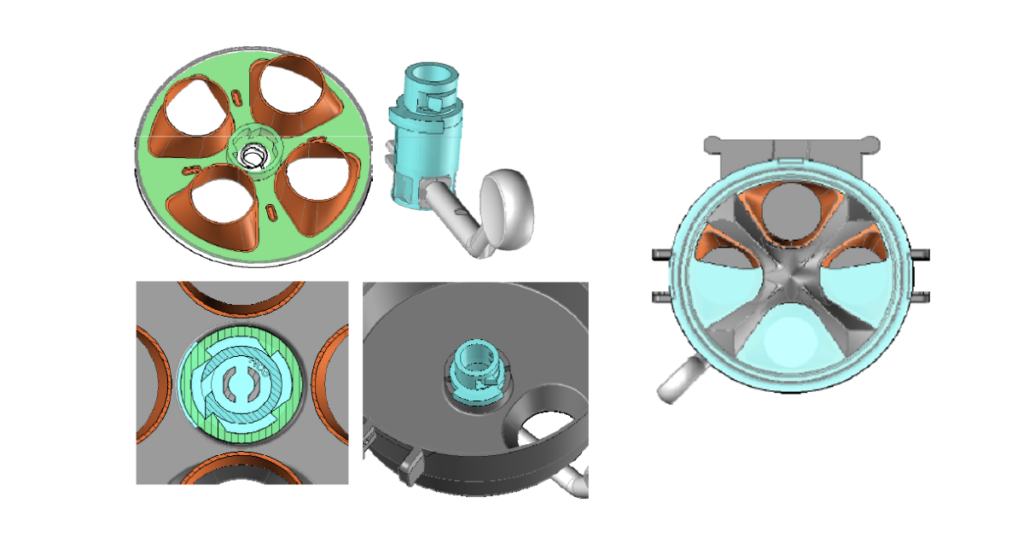
The dosing mechanism passed Japan Patent Office examination and was registered as Japan Patent No. 7580860.
The core claim: a method that converts a lever’s reciprocating motion into one-way rotation via ratchet, rotating a dosing chamber that meters and dispenses bulk powder consistently. The examiner recognized it as a novel approach to powder dispensing, particularly its handling of protein-specific challenges: bridging and rat-holing.
The same patent is currently under examination in the United States.
Where the Technology Goes Next
Across 19 prototypes, Miaomada built up real know-how on metering and dispensing bulk powders. That capability could extend beyond protein, to powdered formula, supplements, spices, and other powder products.
For now, though, protein is the focus. As more people around the world drink protein every day, we want to offer a real alternative to the scoop. The mechanism that took 19 revisions to land on, we believe, is that alternative.
Try the Patented Dosing Mechanism
The ALENNE Protein Dispenser delivers the same dose every pull, a new way to take protein, born from 19 rounds of prototyping.
![Protein Dispenser Development Story [Part 1] — How DP-M1 Came to Be](https://en.miaomada.co.jp/wp-content/uploads/2026/05/004_hero_en-768x403.png)
![Protein Dispenser Development Story [Part 2] — DP-M2: From Setback to the World](https://en.miaomada.co.jp/wp-content/uploads/2026/05/260511_004_part2_en-768x403.png)