
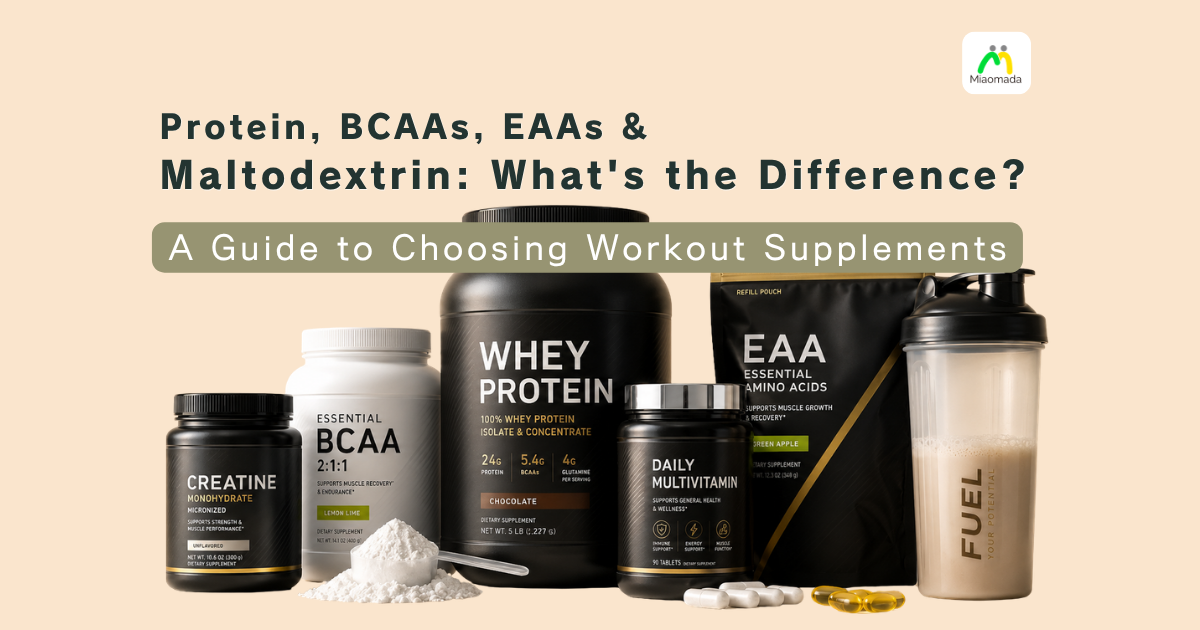
Protein, BCAA, EAA, and Maltodextrin: What’s Different and When to Use Each
Walk down the supplement aisle, online or in a store, and next to the protein sit BCAA, EAA, maltodextrin, creatine, and a row of other names you’ve never had to learn. You bought the protein. Do you need the rest? And what separates BCAA from EAA anyway?
They aren’t competing with each other. Each one has a different job. Below, the main training supplements sorted into 3 groups (protein, amino acids, and carbs), what separates them, when in a session each one fits, and the part that rarely gets covered: what taking BCAA or EAA does to your daily protein math.
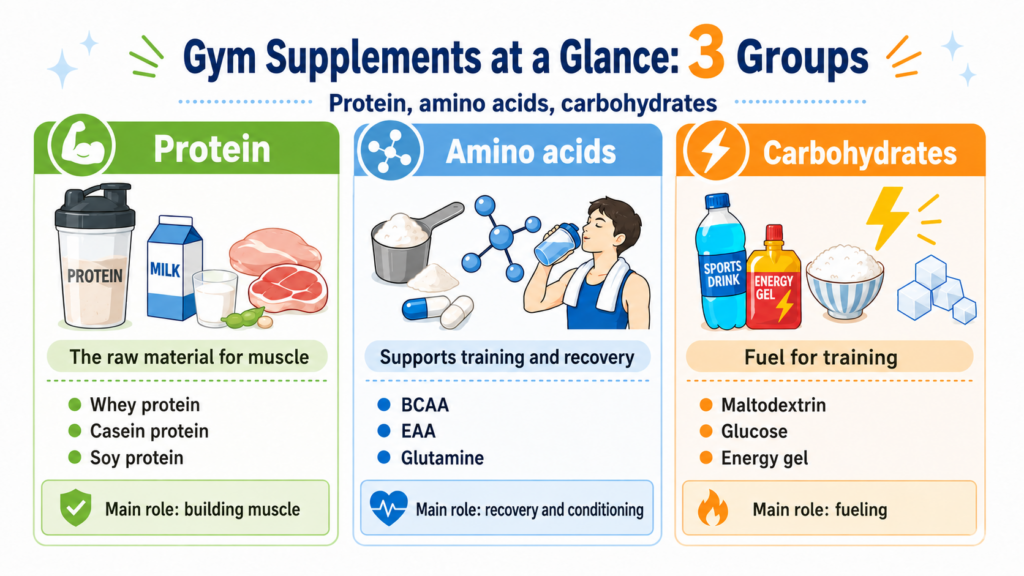
Start by Splitting Them Into 3 Groups
There are a lot of names, but the main training supplements come down to 3 groups, and the view clears up fast once you sort them.
- The protein group: protein powder (whey, soy, casein, and so on)
- The amino acid group: BCAA, EAA
- The carb group: maltodextrin
They do 3 different jobs: supplying the raw material your body is built from, delivering a little of that material fast, and providing fuel to move with. Here’s each in turn.
The Protein Group: The Raw Material Itself
Protein powder is an easy way to top up the protein your muscle, skin, and hair are built from. Of the 3 groups it’s the foundation, and it does the main work of hitting your daily protein intake.
Protein is a large molecule, 20 kinds of amino acid strung together like a chain. Your body has to break it down and absorb it before the amino acids get used, so it arrives more slowly than the standalone amino acid supplements below. In exchange it comes complete, with every amino acid you need already in it.
The Amino Acid Group: BCAA and EAA, Fast and Small
BCAA and EAA are the amino acids that make up protein, supplied already separated out as free amino acids. There’s almost nothing left to digest, which is why they absorb faster than protein powder.
What Separates BCAA From EAA
The two get mixed up often. The difference is how many amino acids each one covers.
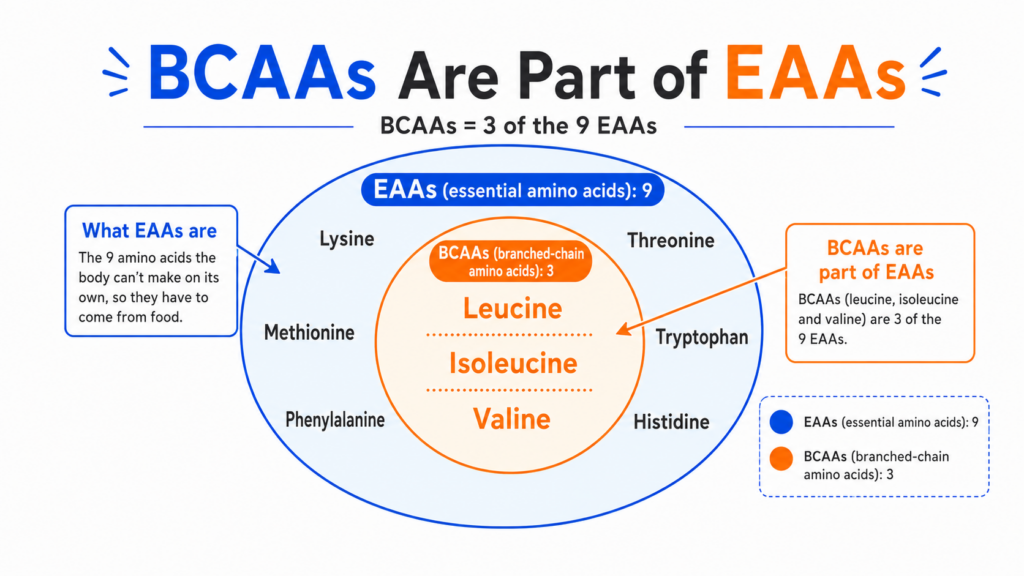
- BCAA: 3 of them, the branched chain amino acids (valine, leucine, isoleucine). An easy way to take in the amino acids most closely tied to building muscle
- EAA: all 9 essential amino acids, the ones your body can’t make. The 3 in BCAA are part of that 9
The point worth knowing is that those 3 alone aren’t enough raw material to build with. Building needs the full set of essential amino acids present, and the thinking is that no amount of the 3 makes up for the ones that are missing. The usual comparison: turning the key gets you nowhere in a car with an empty tank.
That’s why the view has shifted in recent years toward EAA, with the full essential set, over BCAA with only 3.
So Why Not Just Take EAA?
If EAA already covers the full essential set, why bother with protein powder at all? In principle, EAA does work as raw material for building.
In practice, almost nobody runs on EAA alone, and cost is the main reason. Covering a whole day’s protein from EAA supplements costs several times what the same protein costs as powder. EAA is built to top you up quickly in small amounts, and the price doesn’t hold up when you make it the main event.
There’s also the fact that you eat every day. Meat, fish, eggs, and dairy bring protein in on their own, and replacing all of that with expensive EAA makes no sense. Cover the bulk with food and protein powder, then use EAA for what it’s actually good at, a fast top-up around a workout. That’s the practical division.
The Carb Group: Maltodextrin Is Fuel
Maltodextrin is a different kind of thing altogether. It isn’t protein at all, it’s a carbohydrate.
It’s a fast absorbing sugar made by breaking down starch, and its job is replacing the energy you burn through training (the glycogen stored in muscle) and supporting recovery. People use it to head off running out of energy mid-session or straight after, and to add calories when they’re trying to gain weight.
Its purpose has nothing to do with protein, so it doesn’t stand in for your protein powder. It’s fuel to move with, and that’s the whole role.
Before, During, and After Training
Fast amino acids go before and during a session, and complete protein goes after. Absorption speed is what sorts them.
| Timing | What suits it | What you’re after |
|---|---|---|
| Before training | EAA, plus light carbs | Amino acids up before you start, energy in place |
| During training | BCAA or EAA, maltodextrin | Fast amino acids through the session, no energy crash |
| After training | Protein powder, plus carbs | Full raw material for recovery, glycogen back up |
Fast amino acids and fast carbs belong to the moments around and inside a session, where you want something to arrive quickly. Protein powder, the complete material, belongs to the recovery end. For more on timing, see When Is the Best Time to Drink Protein? 4 Patterns, and What the Latest Research Concludes.
How BCAA and EAA Change Your Daily Protein Math
BCAA and EAA count toward your daily protein total, and the labels rarely say so. If you’ve started taking BCAA or EAA, it’s worth thinking through how you count, because that’s where waste and overshooting come from.
Amino Acids Count as Protein Too
BCAA and EAA are, at bottom, the amino acids that protein is made of. So the grams you take in belong in your daily protein total. The catch is that supplement labels usually list them under amino acids rather than protein, and a serving is small, around 10 g. So it’s easy to drink them without ever counting them as protein.
Adding More When You’re Already Covered Does Little
For people who train, the usual protein target is 1.4 to 2.0 g per kg of body weight per day. Once food and protein powder have you at that number, stacking BCAA or EAA on top isn’t expected to add much you can use.
The amounts make it plain. About 43 to 45% of the protein in whey is essential amino acids, so one serving at 20 to 25 g of protein carries roughly 10 g of EAA. That’s about the same as one serving of an EAA supplement.
Drink your protein regularly, in other words, and you’re already taking in an EAA serving’s worth of essential amino acids from the powder. Add an EAA serving on top of that and most of it goes unused.
Working It Out: A 60 kg Example
The International Society of Sports Nutrition puts the requirement for people who train at 1.4 to 2.0 g per kg of body weight per day. Take someone at 60 kg (about 132 lb) training hard enough to need the top of that range: 60 kg times 2 g comes to 120 g a day. One way that breaks down:
| Source | As protein |
|---|---|
| Meals, 3 a day | 70 g |
| Protein powder, about 1 serving | 28 g |
| EAA, 10 g | 22 g |
| Total | 120 g |
The thing to notice is that the EAA is counted as protein. EAA is pure amino acid, so 10 g of it works out to roughly 22 g in protein terms. Japan’s Ministry of Health, Labour and Welfare puts average protein from food at 70 to 80 g a day, so the 70 g from meals is within reach without trying hard.
That’s where the overshoot hides. The model above uses one serving of protein powder. Make it two, around 60 g together, add the 70 g from meals, and you’re at 130 g. Put the EAA on top of that, and 120 g is well behind you. More isn’t better with EAA or protein powder. Counted across a full day, the extra mostly goes spare, and that’s what “adding more when you’re already covered does little” comes down to.
Where in the day that protein powder goes is up to how you live. Push it to the morning if you tend to skip breakfast, split it toward bedtime if you eat 3 solid meals. As long as the daily total is the same, the timing is yours to pick.
How These Powders Do in a Protein Dispenser
Protein powder does best, maltodextrin often works, and BCAA or EAA don’t suit the current mechanism. These are all powders, so it’s worth asking how each behaves in a tool you decant powder into and measure out of.
| Supplement | Fit with a dispenser | Notes |
|---|---|---|
| Protein powder | Excellent | What it’s built for. Smooth with a standard, loose powder |
| Maltodextrin | Workable | Fine if the powder is as loose as protein. Varies a lot by product |
| BCAA and EAA | Poor | Very fine particles that kick up easily, so the current mechanism isn’t suited to them |
Protein powder does best because its flowability sits right in the range the mechanism wants. Some maltodextrin products come out nearly as loose as protein, and those are workable.
BCAA and EAA have very fine particles that lift into the air as you pour them in. Handling powders that fine is a development question we’re still working on. For now, the straight answer is that BCAA and EAA will go in but aren’t suited to it.
In Summary: Not Competitors, Different Jobs
- Sorting the main supplements into protein, amino acids (BCAA and EAA), and carbs (maltodextrin) makes the picture clear
- Protein powder is the complete material and the daily foundation. BCAA and EAA are the fast small delivery, and carbs are fuel
- BCAA covers 3 amino acids, EAA all 9 essentials. The 3 alone fall short, and building needs the full set present
- BCAA and EAA count toward your daily protein. If you’re already at your number, adding them does little, and they don’t stand in for protein powder
Supplements don’t get better as you add names to the shelf. Build the foundation with protein powder and food first, then fill the gaps with the fast, small options where you need them. Once the division of labor is clear, choosing gets a lot simpler.
The ALENNE Protein Dispenser
The ALENNE Protein Dispenser is Miaomada’s flagship product: pour straight from the bag or tub into the hopper, slide the lever to measure a set dose, and keep it on the counter as part of your daily routine.
Protein powder is the one you’ll be measuring every day, whatever else ends up on the shelf. That’s the one this was built around.


![Inside Two Successful Makuake Crowdfunding Campaigns [Part 2]: DP-M2, Building for the World](https://en.miaomada.co.jp/wp-content/uploads/2026/04/260428_008_part2_en-768x403.png)
![Protein Dispenser Development Story [Part 1] — How DP-M1 Came to Be](https://en.miaomada.co.jp/wp-content/uploads/2026/05/004_hero_en-768x403.png)