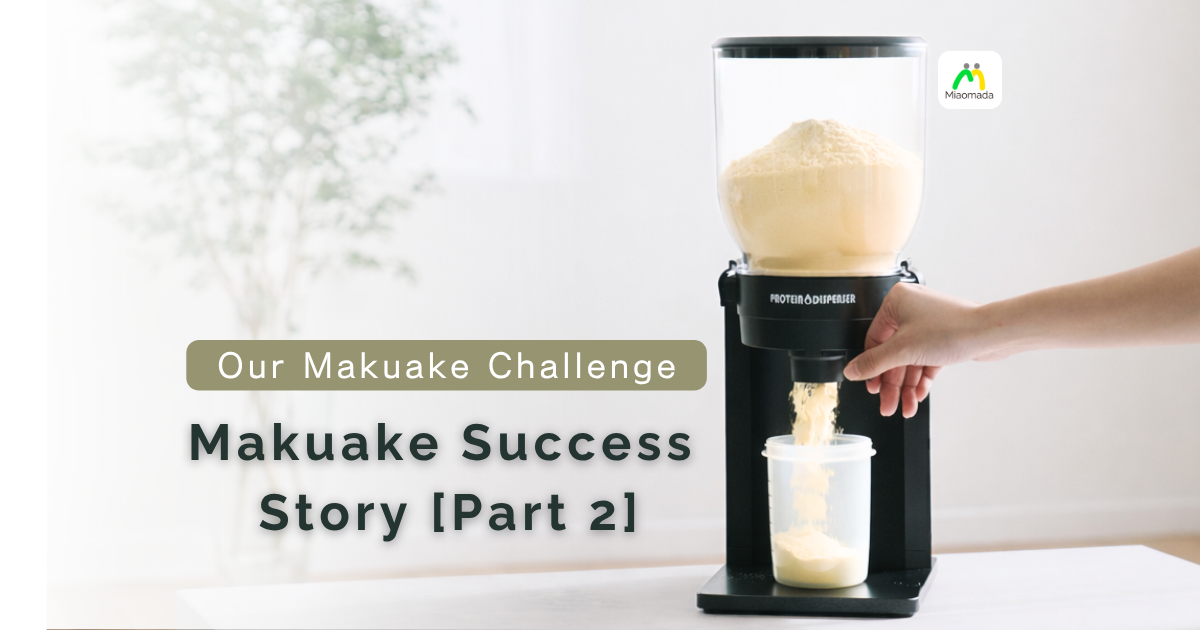
Inside Two Successful Makuake Crowdfunding Campaigns [Part 2]: DP-M2, Building for the World
Part 1 followed the first Makuake campaign for DP-M1: the material challenges, the mid-campaign spec change, and shipping on time against the odds.
Part 2 is where we took everything we learned and built something better, the DP-M2, and the Makuake campaign that followed.
The Limits of DP-M1: “This Alone Isn’t Going to Work”
During those weeks of dosing 100 different proteins for DP-M1, one realization stuck with me.
Protein powders vary wildly brand to brand, flavor to flavor. DP-M1’s dosing approach couldn’t handle a lot of them. With that mechanism alone, we’d never get to a dispenser that truly works with any protein.
That conviction kept building while I started on the next product.
From a Failed Motorization to a 360-Degree Rotating Chamber
The first thing I tried was electrification, a button press, and the dose is done. We ended up abandoning that direction. The full story is in Development Story Part 2.
What survived from that failure was the idea of a dosing chamber that rotates 360 degrees. Repurposed as a manual mechanism (pull a ratchet lever to advance the rotation), it gave us a design that didn’t run into prior US patents.
We started development in April 2023. The concept came together in about a month. DP-M1 had used a 120-degree lever swing; DP-M2 changed the rotation angle and added a nozzle. Once the concept was set, we commissioned a US patent search, folded in the patent attorney’s suggested revisions, and moved forward.
The Rat-Holing Problem: Powder That Won’t Leave the Walls
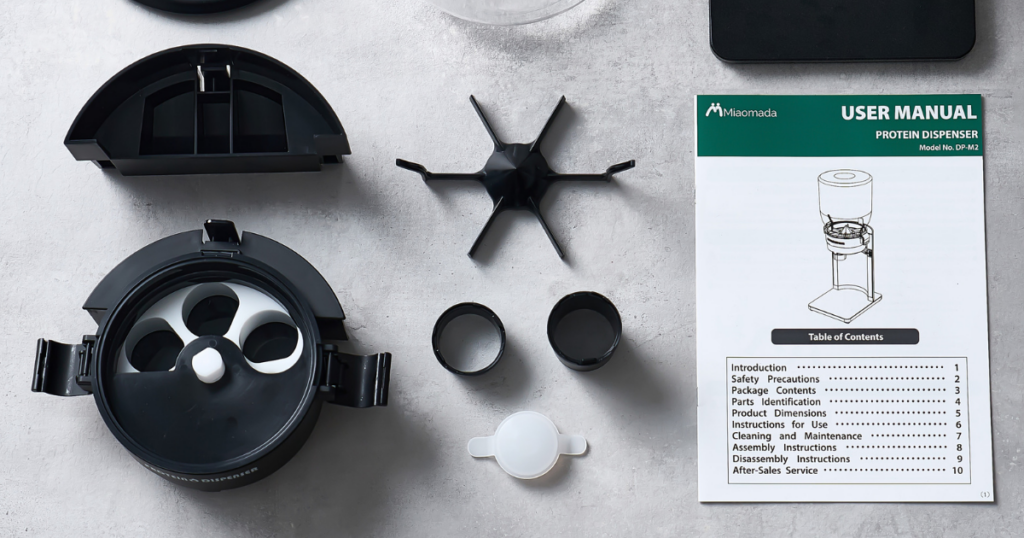
The dosing mechanism itself came together fairly smoothly. The hard part was the section above it: getting powder to actually drop from the hopper into the dosing chamber.
DP-M2 has a larger opening below the hopper than DP-M1 did, to encourage powder flow. But that larger opening made the rat-holing problem worse.
Rat-holing is when powder funnels straight down the center of the container while the walls hold residual powder in place. From the outside, the container looks emptier than it actually is; the powder stuck to the walls never drops, and dose accuracy gets worse with every pull.
The fix was in the agitator vanes. We reshaped them over and over; long vanes, short vanes, different counts. Change one variable, run a dosing test, repeat. Eventually we landed on a geometry that consistently pushed powder off the walls
Six Dosing Chambers: and the Base Plate Problem Comes Back
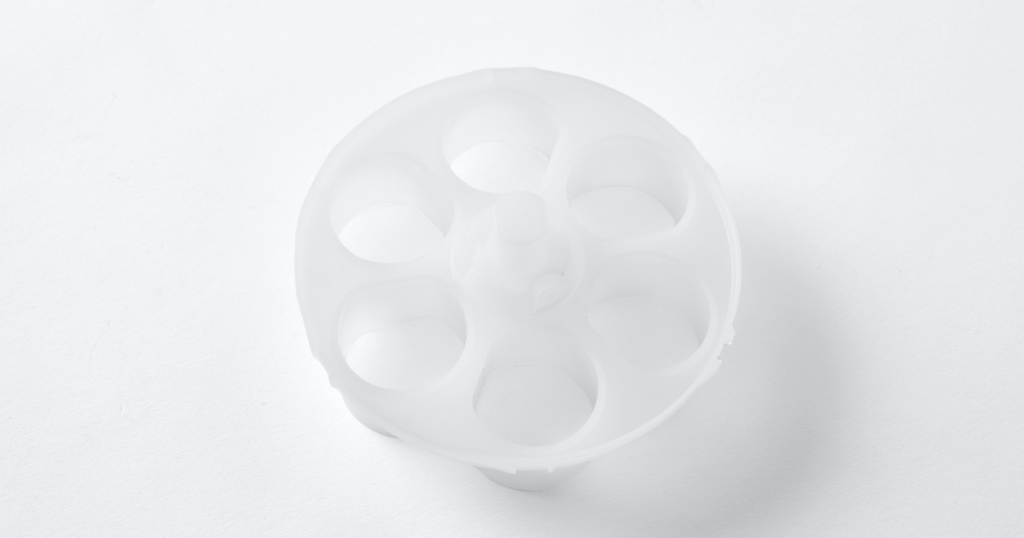
DP-M1 had two dosing chambers. DP-M2 has six. The change improved accuracy and consistency, but rotating the chamber got significantly harder.
With DP-M1’s base, operating the lever moved the whole product around. The base had to be larger, heavier, more stable.
Part count went from 15 to 17. We built 11 new molds, mostly around the new dosing section. DP-M2 tooling alone came in at ¥14,850,000 (about US$99,000). Including DP-M1’s modifications and revisions, total tooling investment topped ¥36M (about US$240,000).
The Material Problem: Japan’s Food Sanitation Act Wasn’t Enough
DP-M2 was built with the US market in mind from the start. That meant we needed materials that complied not just with Japan’s Food Sanitation Act, but also with US FDA regulations.
Material selection got hard again.
No Japanese domestic supplier had an ABS grade compliant with both specs, so we ended up sourcing from Taiwan, Chi Mei for ABS and Hua Fu (華孚) for PS.
POM was already compliant under both Japanese and US regulations, so that carried over from DP-M1.
The one surprise was the dosing chamber: we’d planned on PP (polypropylene), but the molded parts didn’t have the strength we needed. So we switched to POM there as well.
FDA Testing: A First-Time Experience, Waiting for the Result
Material compliance on paper isn’t enough. The actual molded parts had to be sent to a test lab, analyzed, and certified.
This was new territory for us. We had to start by finding a lab. Once we’d shipped the test parts, the wait was nerve-wracking. Until the report came back, there was no way to know whether it would actually clear.
It passed without complications. But the experience drove home how much extra work goes into preparing a product for overseas markets.
Why We Stopped Including a Dose Guide: Same Protein, Different Powder
DP-M1 shipped with a printed dose guide. DP-M2 does not.
The reason was that when we re-purchased some of the same proteins we’d tested for DP-M1 (same brand and product), the powder was noticeably different than before.
When we checked with the manufacturer, they told us the raw ingredient supplier can change between lots, which can shift the powder behavior. If that happens with a major brand, it’s safe to assume it happens with others.
So any dose guide we printed could be wrong by the next time someone bought that same protein. A dose guide that’s only sometimes right isn’t worth printing, so we dropped it for DP-M2.
The Second Makuake Campaign: 179 People Chose “Next”
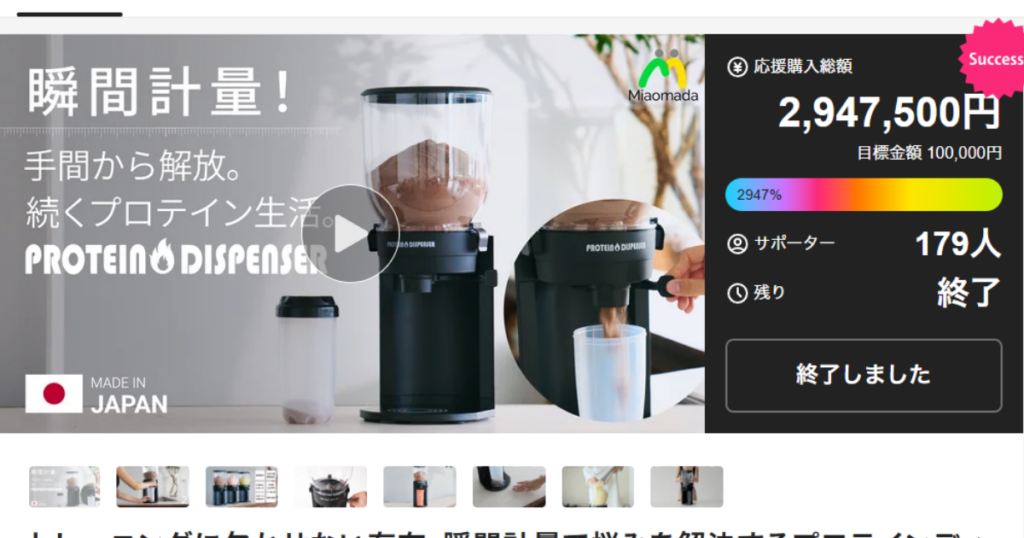
November 2024. DP-M2’s Makuake campaign launched.
We used the same project page agency that had built the DP-M1 page. We worked with a tighter group of influencers this time, mostly people who’d helped us with DP-M1.
We also built a landing page with a LINE flow for ongoing communication. Honestly, we got as far as collecting LINE followers and broadcasting to them. There’s more we could have done with it, but that’s a next-time problem.
Even so, the results spoke for themselves: 179 backers and ¥2,947,500 (about US$19,650). Roughly 35% more backers than DP-M1, and over 55% more revenue. Having DP-M1 already out there mattered more than I expected.
Patent Granted, Then a US Filing
Once DP-M2 development wrapped up, we filed a Japanese patent. It was granted as Japan Patent No. 7580860, and a US application is currently under examination.
The ‘Protein Dispenser’ trademark is registered in both countries. The category is new enough that owning the name matters.
And Now, Round 3: Kickstarter
Two Makuake campaigns later, the next stage is Kickstarter in the US.
312 backers in Japan said they wanted this. The patent is granted. FDA compliance is in. Materials and tooling are ready for a product that ships globally.
Selling into a different language, a different market, a different culture is a completely different fight from Makuake. But DP-M1 taught us that when something breaks mid-project, you face it instead of running, and that’s a lesson worth carrying into any market.
For more on the product’s development arc, see Development Story Part 1 and Part 2. For the engineering behind the dosing mechanism, see 19 Prototypes to a Dosing Mechanism.
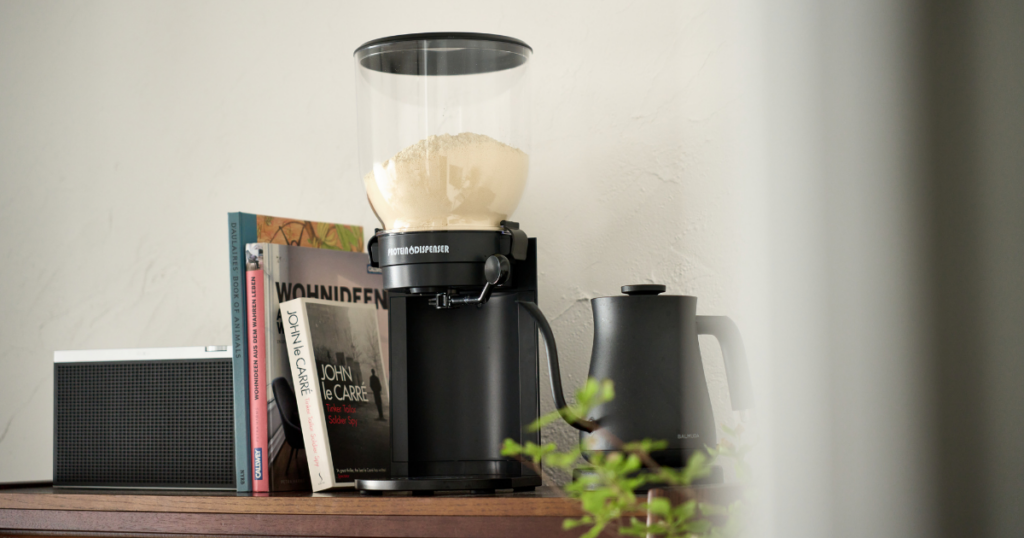
The ALENNE Protein Dispenser is a Japan-made dispenser, chosen by 312 Makuake backers across two campaigns. One pull, one measured serving. Up to 1 kg storage and a nozzle designed to keep your counter mess-free.

![Inside Two Successful Makuake Crowdfunding Campaigns [Part 1] — DP-M1, Setting Off From Zero Recognition](https://en.miaomada.co.jp/wp-content/uploads/2026/04/260424_008_part1_en-768x403.png)