When Is the Best Time to Drink Protein? 4 Patterns, and What the Latest Research Concludes
“When’s the best time to drink protein?” It’s one of the questions I hear most, both from people who’ve just started taking protein and from people who’ve been at it for a while. Magazines and websites cover it constantly, but the answers are scattered all over the place, and it’s hard to know which one to trust.
This article sorts out the four main times people drink protein (morning, pre-workout, post-workout, and before bed), using what current sports nutrition research says. Here’s the conclusion up front: the timing matters far less than your total protein intake for the day. That’s close to the consensus position in sports nutrition right now.
The Bottom Line: Total Daily Intake Beats Timing, by a Lot
For years, protein timing was ruled by the idea of a “golden window” in the 30 minutes after a workout. Recent research has shifted that picture quite a bit.
The turning point was a meta-analysis on protein intake timing published by Schoenfeld et al. (2013). Pooling and reanalyzing several earlier studies, the analysis found:
- When timing alone is compared, drinking protein right after training does look better for muscle growth.
- But once total daily protein intake is equalized across groups, the timing difference disappears.
- In other words, the real reason the post-workout group looked better was simply that they were taking in more total protein.
Based on current research, the factor with the strongest influence on muscle growth and strength is your total daily protein intake. Timing is secondary.
The “anabolic window” (see the glossary at the end) also turns out to be far wider than the old “within an hour of training.” Muscle protein synthesis (MPS) stays elevated for several hours around a workout, and in some studies for 24 hours or more.
With that as the backdrop, let’s go through what each timing window is actually good for.
The 4 Main Times to Drink Protein
Protein timing generally breaks into four patterns:
- First thing in the morning
- Before training
- After training
- Before bed
Each one suits a particular kind of person, and a particular goal.
1. First Thing in the Morning
You go about 7 to 8 hours through the night without eating anything. When you wake up, your body has gone a long stretch with no protein coming in.
If you eat a solid, protein-rich breakfast, there’s no need to add a shake on top. But if your mornings look like “just bread and coffee” or “no time to eat, straight out the door,” then using protein to lock in one meal’s worth is a good way to lift your total for the day.
Think of the morning shake less as a performance strategy and more as a strategy for hitting your daily total.
2. Before Training
The point of drinking protein before you train is to keep amino acids available during the workout so the supply doesn’t run dry.
If you train while your body is low on amino acids, it’s more likely to break down muscle for energy (the catabolic process). To hold that off, the pre-workout camp takes protein about 30 minutes to an hour before training.
Research suggests MPS gets stimulated as long as amino acids are available, even mid-workout, so having protein on either side of the session works fine for building muscle. Some people don’t like training with something in their stomach, so adjust the timing between 30 and 60 minutes beforehand based on how you feel.
3. After Training
This is the one that got called the “golden window.” For years the line was “drink it within 30 minutes of finishing.”
As noted above, recent research treats that narrow 30 minute limit as much looser than it was made out to be. Your muscles stay sensitive to protein for several hours, up to 24 hours, after training, so there’s no need to panic about getting a shake in during the 30 minutes between leaving the gym and getting home.
That said, taking 20 to 25 g of quality protein during the post-workout recovery period is still a solid option for shifting the protein balance back toward building, since exercise pushes it toward breakdown. If you’re in the post-workout camp, getting it in within 1 to 2 hours is plenty by current understanding.
4. Before Bed
The one that’s gained the most attention over the past decade or so is protein before bed.
The MPS that ramps up after a workout won’t hold if amino acids stop coming in during sleep. Several studies show that taking 20 to 30 g of protein before bed (especially a slow absorbing one like casein) keeps blood amino acid levels steady through the night and promotes overnight muscle protein synthesis.
In studies on lifters and athletes, before-bed protein has also been reported to improve training adaptation and gains in strength and muscle.
Some people feel it sitting heavy in the stomach, so 1 to 2 hours before bed works better than right as you’re lying down.
Best Timing by Lifestyle
To figure out what’s realistic for you, the fastest route is to work backward from your daily routine.
| Lifestyle | Suggested timing |
|---|---|
| Light or skipped breakfast | First thing in the morning |
| Midday training | 1 hour before training |
| Straight to the gym after work | After training |
| Work from home, irregular meals | Twice: morning and post-workout |
| Serious about building muscle | Twice: post-workout and before bed |
| Go to bed on an empty stomach | 1 to 2 hours before bed |
Rather than “this is the correct answer,” the best time ends up being whichever one fits your rhythm without forcing it.
How Much Should You Drink a Day? Target Totals

The whole point so far has been that total matters more than timing. So how much should you aim for in a day?
Current sports nutrition lays out the targets roughly like this:
- Generally active people: 0.8 to 1.0 g per kg of body weight (close to standard public health recommendations for the general population)
- People training with resistance regularly: around 1.6 g per kg
- People cutting who don’t want to lose muscle: 1.2 to 2.0 g per kg
- Per meal: 20 to 25 g of quality protein, spread across 3 to 4 times a day
A 70 kg person training hard is looking at roughly 110 g of protein a day. Some people cover that with food alone; others build it from 20 g per meal plus one or two shakes.
The cutting phase deserves extra care. When you cut calories, protein intake tends to drop with them, and the muscle you worked to build can come off alongside the fat. The rule for a cut is “lower total calories, but if anything, raise your protein.”
My Take: I Drink It an Hour Before Training
From here it’s personal practice.
I find I feel best drinking protein about an hour before I train, for two reasons.
First, guarding against catabolism. I don’t want to put my body in a state where it’s short on amino acids mid-workout.
Second, managing hunger. In my case, the route from wrapping up work to heading to the gym leaves no room to fit a meal in between. Going straight from work to training, I always feel hungry, so I drink a shake before I get to the gym. That takes the edge off the hunger and keeps amino acids flowing during the session.
An hour out is the ideal, but depending on the commute I sometimes drink it right before training. I don’t get too strict about it; I fit it to how the day actually moves.
Writing this article actually changed one thing for me. I found that before-bed protein looks more effective than I’d assumed. Another shake 1 to 2 hours before sleep is a pattern I’m thinking about trying next.
What Matters More Than Timing Is Being Able to Keep It Up
I’ve spent this article sorting out timing, but here’s the more honest take.
Optimizing timing matters far less than being able to keep it up every day. Whether you’re hitting your total daily protein is one of the big factors that decides the result. On top of that, your training itself and how you handle sleep and recovery matter just as much. Protein alone doesn’t decide the outcome.
The more tired you are, the more you go looking for a reason to skip: “I can’t drink it at the ideal time today, so there’s no point training anyway.”
The more you fixate on timing theory, the more of these “reasons not to” you collect.
Better to drink it even if the timing is a little off, and train anyway. Keeping that going gets you results more reliably.
And the simplest way to keep it going every day is to fix the timing to the same time each day and tie it to something you already do. New habits are hard to make stick, so if you try to slot protein in as its own standalone action, it never finds a place in your day and quietly disappears.
- One before you make your morning coffee
- One when you go to grab your gym bag
- One before you brush your teeth after dinner
- One during your bedtime reading
Pairing it with something you already do naturally folds it into your day.
I’ve written in more detail about keeping the habit going in Why You Stop Drinking Protein, and How to Stay With It.
If you’ve settled on a timing but can’t seem to keep it up, give that one a read too.
If “Prep Effort” Is What’s Getting in the Way
One big reason people can’t keep it up, even after settling on a timing, is the prep effort.
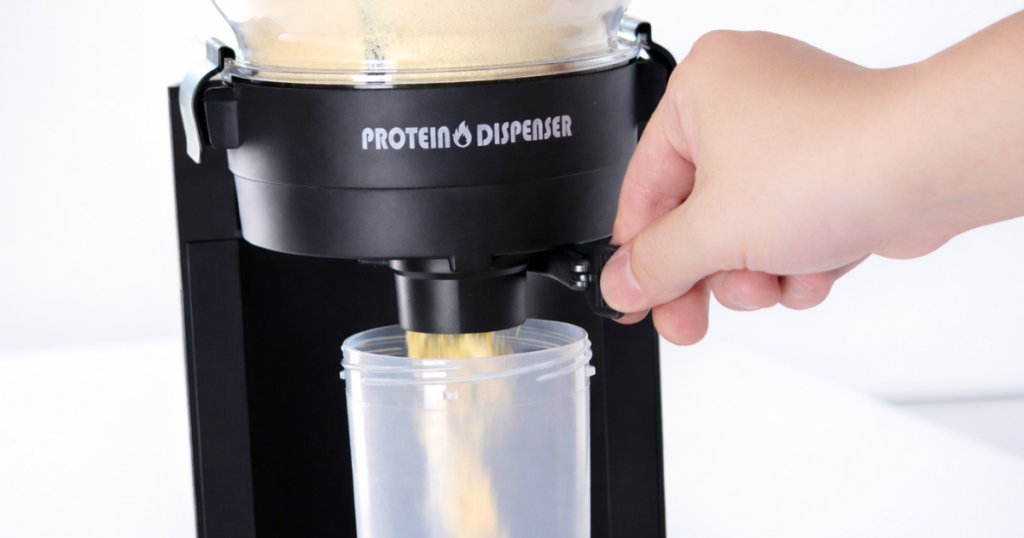
Measuring with a scoop, the spilling, transferring to the shaker, sealing the bag. One or two minutes of small effort each time, and it adds up on busy mornings and tired nights. Decide to drink it twice a day, and that effort simply doubles.
There’s a way to make the same daily task shorter. The ALENNE Protein Dispenser is a patented measuring tool that delivers a set dose of powder with a single lever pull. It handles storage and measuring for up to 1 kg in one unit, so the morning prep drops from 10 steps to two or three.
If “I set a timing but can’t keep it up” sounds like you, start by rethinking the measuring and storage. The ALENNE Protein Dispenser was built for exactly that part of the routine.
Glossary
- Anabolic window: The stretch of time after exercise when taking in nutrition especially raises muscle protein synthesis (the work of building muscle). It used to be described as “30 minutes to an hour after exercise,” but it’s now thought to last several hours, up to 24 hours.
- Muscle protein synthesis (MPS): The process of building new muscle protein in the body. Both training and protein intake make it more active.
- Catabolic: The state where the body, short on energy, breaks down muscle to use as an energy source. It’s more likely when amino acids run low mid-workout, which is why taking protein around exercise is meant to hold it off.
- MPS sensitivity: The state after exercise where muscle responds readily to nutrition and raises synthesis. The time when this sensitivity is elevated is the “anabolic window.”
![Protein Dispenser Development Story [Part 1] — How DP-M1 Came to Be](https://en.miaomada.co.jp/wp-content/uploads/2026/05/004_hero_en-768x403.png)
![Inside Two Successful Makuake Crowdfunding Campaigns [Part 2]: DP-M2, Building for the World](https://en.miaomada.co.jp/wp-content/uploads/2026/04/260428_008_part2_en-768x403.png)