
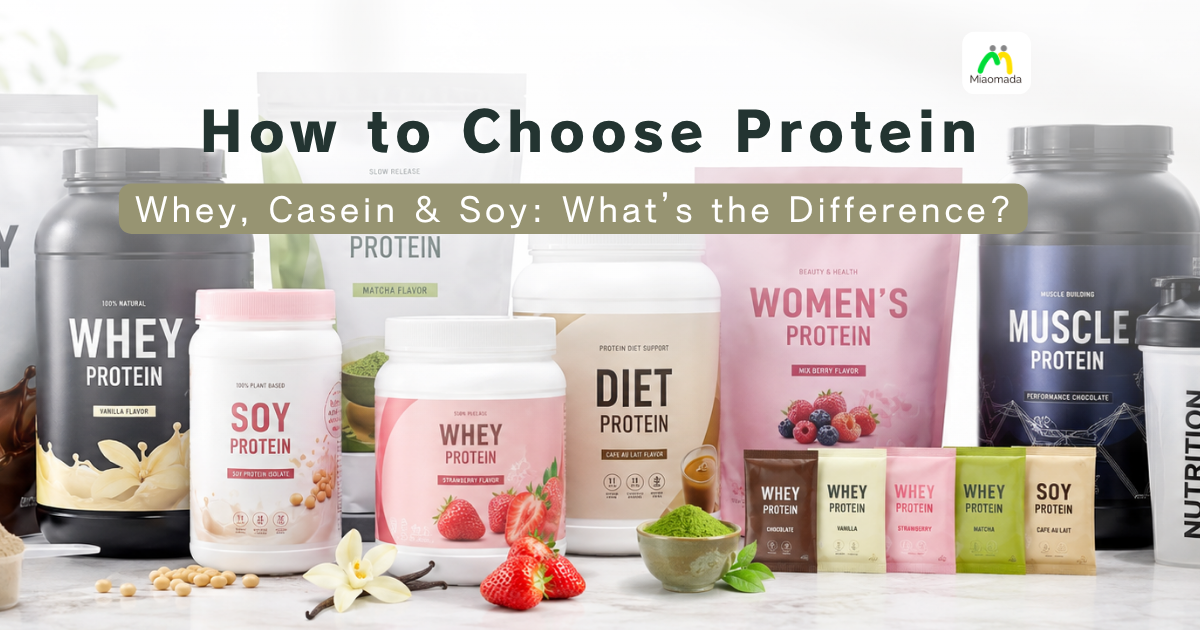
Types of Protein Powder and How to Choose: Whey, Casein, and Soy, Sorted by Goal
Walk down the protein aisle or open a product page, and you get whey, casein, soy, and then WPC and WPI, none of it explained. Picking one gets confusing fast.
There are only 3 things you actually need to check: what it’s made from, how fast it absorbs, and whether that fits what you’re after. Below, the 3 basic types, what WPC and WPI change inside the same whey, and how to choose by goal.
The 3 Main Types of Protein Powder: Whey, Casein, and Soy
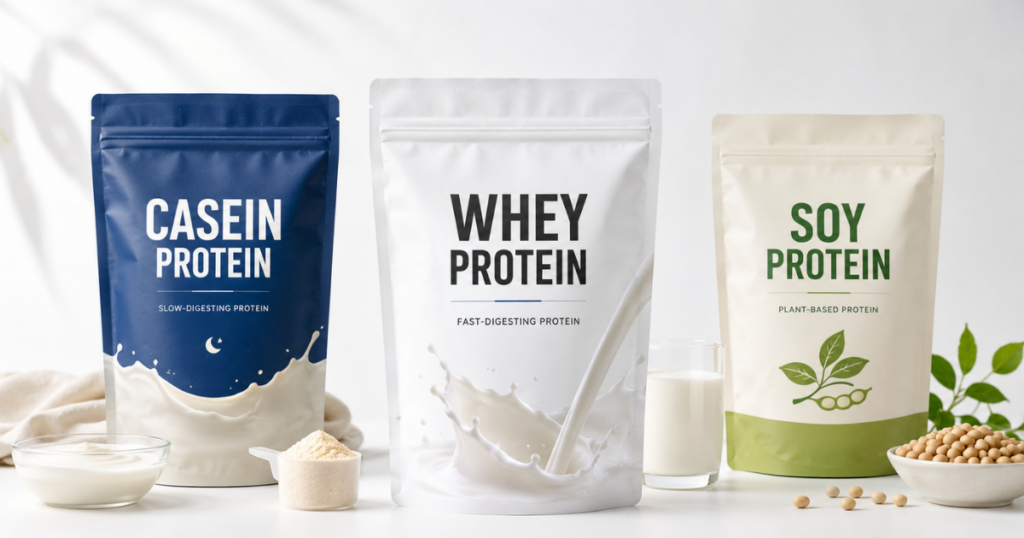
Most protein on the shelf splits into 3 groups by raw material: whey, casein, and soy.
Whey Protein: Fast Absorbing and the Default Choice
Whey comes from milk. About 20% of milk protein is whey, and the clear liquid that pools on top of a tub of yogurt is the easiest way to picture it.
Its main advantage is speed. Blood amino acid levels tend to peak roughly 60 to 90 minutes after you drink it, which makes it a good fit for the moments around training when you want protein to arrive quickly. It also carries the most BCAAs of the 3 types, leucine in particular, and those are what muscle is built from.
Whey is the most widely sold type, so it’s also relatively cheap, and it’s the standard answer when you can’t decide.
Casein Protein: Slow and Steady Supply
Casein also comes from milk, and it makes up the other 80% of milk protein. It digests slowly in the stomach, releasing amino acids gradually over 6 to 8 hours.
That’s why it’s the usual pick before bed. In one study, a group that took casein before sleeping showed higher overnight muscle protein synthesis. It also works as a bridge for anyone whose meals end up spaced far apart during the day.
Soy Protein: The Plant-Based Option
Soy is a plant protein made from soybeans. Plant protein has a reputation for being the weaker option, and that’s a misunderstanding: soy is a complete protein, with all the essential amino acids in reasonable balance. Its absorption speed generally lands somewhere between whey and casein.
It also contains soy isoflavones, which whey and casein don’t. And because there’s no dairy in it, it’s an option if milk upsets your stomach or if you’re eating plant-based.
The 3 Types Side by Side
| Whey | Casein | Soy | |
|---|---|---|---|
| Source | Milk (whey fraction) | Milk | Soybeans |
| Absorption | Fast, peaks in 60 to 90 minutes | Slow, spread over 6 to 8 hours | In between |
| BCAA content | Highest | Lower than whey | Lower than whey |
| Best for | Around training, mornings | Before bed, between meals | Meal replacement, plant-based diets |
WPC vs WPI: Same Whey, Different Purity
Whey packaging carries either WPC or WPI. That’s the refining method, and it changes what’s in the bag more than you’d expect.
- WPC (whey protein concentrate): Around 70 to 80% protein. Some lactose and milk fat stay in, which is why it tastes better and costs less. Most whey on the shelf is WPC.
- WPI (whey protein isolate): Refined to 90% protein or higher, with under 1 g of lactose per serving. It usually sits better with people whose stomachs react to milk, and it costs more.
There’s also WPH (hydrolyzed whey), broken down in advance so it absorbs faster still, but it’s expensive and tends to taste bitter. Starting with WPC or WPI is enough.
One thing WPI does not do is build more muscle. The difference is purity, lactose, and price, so choose on how well you handle lactose and what you want to spend.
How to Choose Protein by Goal
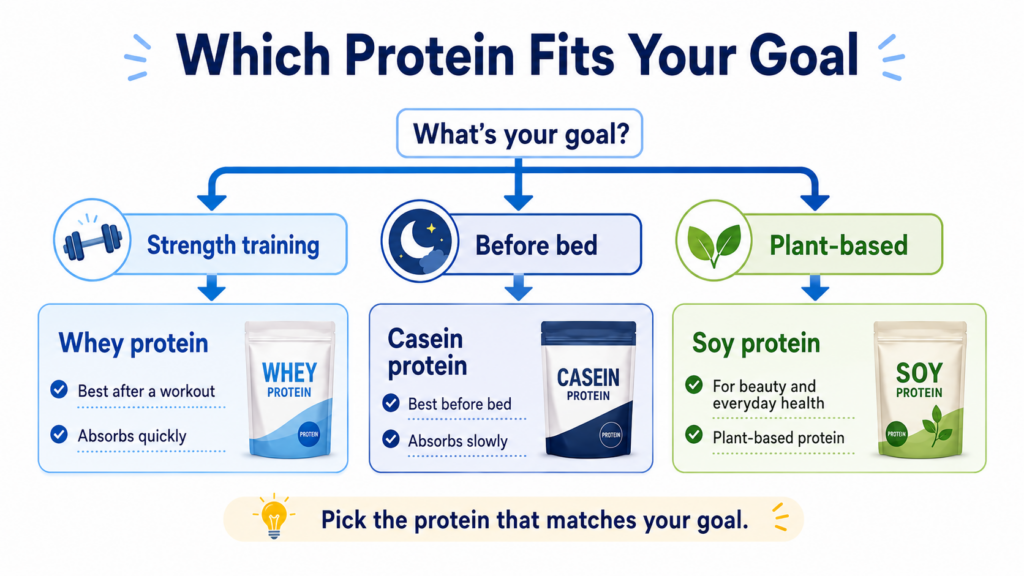
Match the absorption speed to the goal: whey for training, casein before bed, soy for plant-based eating.
For Building Muscle
If you’re training, whey is the first choice: fast, and high in leucine. Most people picture drinking it after a session, but you can use that speed the other way and take it about an hour before, so you start with blood amino acids already up. For people who train, the usual target is 1.4 to 2.0 g of protein per kg of body weight per day, and the basic approach is to use whey to cover whatever your meals don’t. For how the timing works out, see When Is the Best Time to Drink Protein? 4 Patterns, and What the Latest Research Concludes.
For Weight Loss Support
Of the 3 macronutrients, protein tends to be the most filling, which makes it useful as a snack or a swap while you’re cutting. Casein and soy digest slowly and tend to stay with you longer, so plenty of people reach for one of them instead of a snack. Drinking it won’t take weight off by itself, though, so it only works alongside managing total calories and how much you move.
For Skin, Hair, and Everyday Health
Skin and hair are built from protein too. If you don’t eat much and tend to fall short, a powder is an easy way to top up. Soy isoflavones have drawn interest around women’s health, and more people are choosing soy with that in mind. Taste and how easy a powder is to keep drinking vary a lot from person to person, so start with a small bag.
For Staying Healthy From Your 40s On
Muscle mass drops off gradually with age, a decline known as sarcopenia. What’s generally understood to help is exercise plus 25 to 30 g of good protein at every meal, not just at one of them. Breakfast is usually the meal that falls short, so adding fast absorbing whey there is the easiest place to start.
For Drinking Before Bed
Casein is the standard here, for the slow release. Most of the studies use 20 to 40 g about 30 minutes before sleep.

Why the Same Brand Can Feel Different: Raw Material Lots
The same product can come out with a different texture from one bag to the next, because the raw material arrives in lots that vary. You buy the same brand again, and the powder that flowed freely last time is now damp enough to drop off the spoon in a lump. That happens more often than you’d think.
Even for Japanese brands, the whey itself is almost all imported, from New Zealand, Australia, the EU, and the United States. Raw milk varies by season, and the conditions during drying shift the bulk density (how tightly the powder packs) and how freely it flows.
That affects anything measured by volume. One level scoop of a densely packed powder weighs more than one level scoop of a light, airy one. It’s also why manufacturers won’t commit to ‘one scoop = X grams’ for the scoop in the bag.
We learned this the hard way. For the first protein dispenser, we measured over 100 brands of protein repeatedly and published a dosing table brand by brand. But if the powder can change lot to lot inside a single brand, a fixed table doesn’t match reality. So from the current model on, we give the dose as a range instead. When you open a new bag, check the first dose or two, and you’ll know where you stand.
What Matters as Much as the Type: A Setup You Can Keep
Whichever type you land on, 2 problems follow you: storing the powder after you open it, and measuring it every single time.
Pick the perfect type for your goal, then let it cake up in the humidity or quit because scooping every morning wears you down, and you’re back where you started. On storage, see What Actually Matters in Protein Storage Wasn’t “Sealing It Tight” and Protein Powder Shelf Life and the Signs It’s Gone Off.
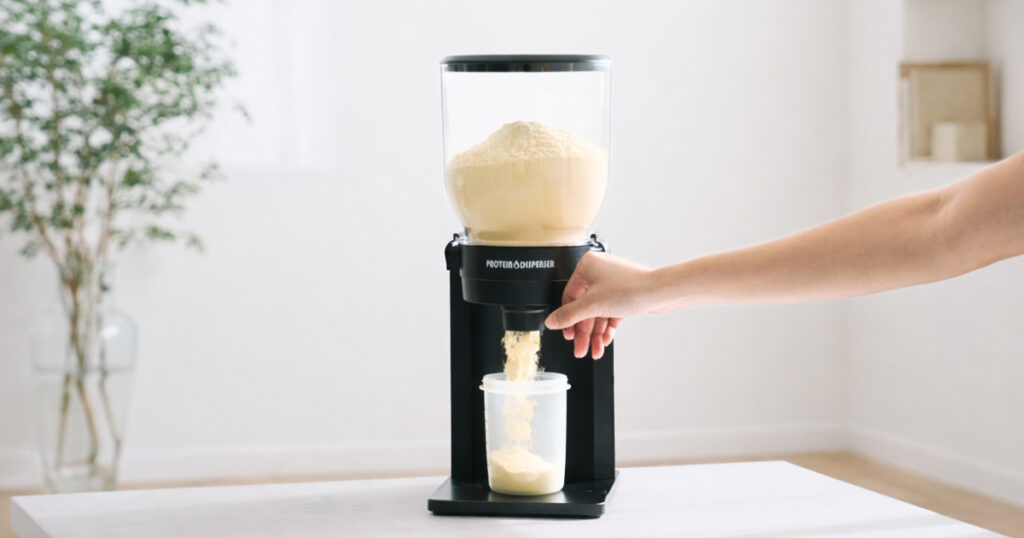
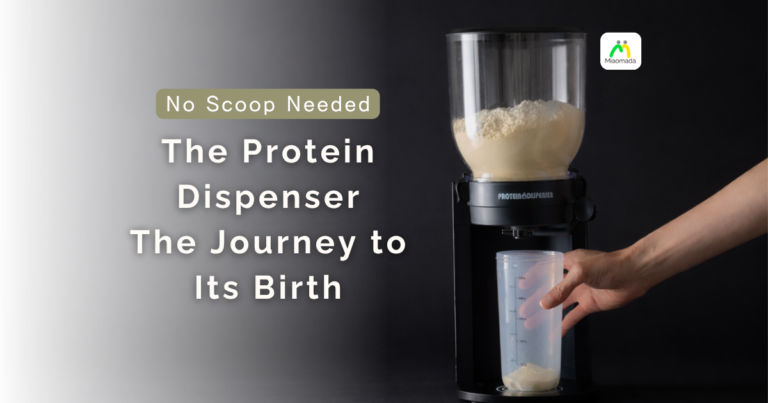
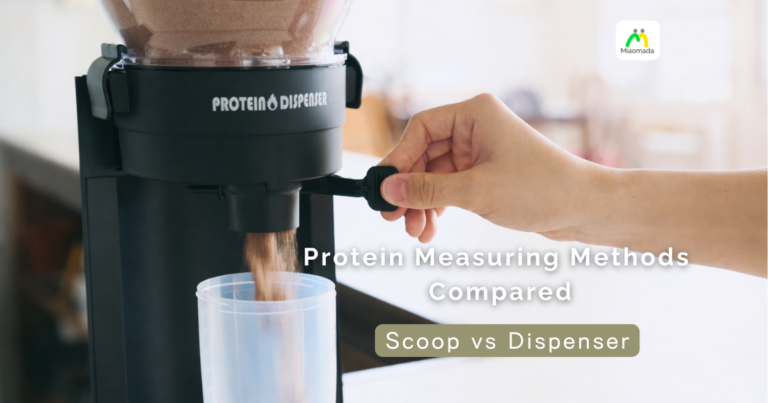
The ALENNE Protein Dispenser we build at Miaomada handles both in one unit. Pour from the bag or tub into the hopper, and one pull of the lever measures roughly 10 to 15 g straight into your shaker, with no scooping and no powder across the counter. For the patented dosing mechanism (Japan Patent No. 7580860), see What Is a Protein Dispenser? How It Works and Why It Matters.
In Summary: Once You Know the Differences, Choosing Gets Simple
- Powders split into 3 types by source. Whey if you can’t decide, casein before bed, soy if you want plant-based
- Within whey, WPC is the standard. Look at WPI if milk upsets your stomach
- Match absorption speed to the goal: training, cutting, skin and everyday health, or staying healthy with age
- The same brand can vary by lot, so treat the dose as a range and check once when you open a new bag
- Whatever you choose, storage after opening and measuring every time decide whether you keep it up
Choosing a type is only the first step. Once you’ve found the bag that suits you, the rest is building a setup you can keep without much effort. That’s the part that shows up in your body a few months later.
The ALENNE Protein Dispenser
The ALENNE Protein Dispenser is Miaomada’s flagship product: pour straight from the bag or tub into the hopper, slide the lever to measure a set dose, and keep it on the counter as part of your daily routine.
Whichever type you settle on, the powder still has to be stored and measured every day. That’s the part we built it for.

![Protein Dispenser Development Story [Part 2] — DP-M2: From Setback to the World](https://en.miaomada.co.jp/wp-content/uploads/2026/05/260511_004_part2_en-768x403.png)