The Protein Spill Problem: Let’s End It. Every Cause, Every Fix, in One Place
The first wall most people hit when they start drinking protein is the spilling.
Open the bag, scoop, transfer to the shaker. That’s all it should be. But somehow the kitchen counter ends up coated in powder. Your hands are coated. And while your hands are still covered, you’re turning on the faucet, screwing the shaker lid on. You do all of this in the busy stretch before work.
I drink protein every morning, and to be honest, the spilling itself bothered me, but the feeling of powder on my hands bothered me just as much. You don’t want to touch anything when your fingers are dusted in whey.
For a long time I assumed this was unavoidable. “It’s protein. It spills. That’s how it is.”
Turns out there’s actually a reason it happens, and there are real fixes. This article walks through where the spilling comes from, what you can try right away, and what it takes to stop it for good.
Why Protein Spills, and Why It’s So Annoying
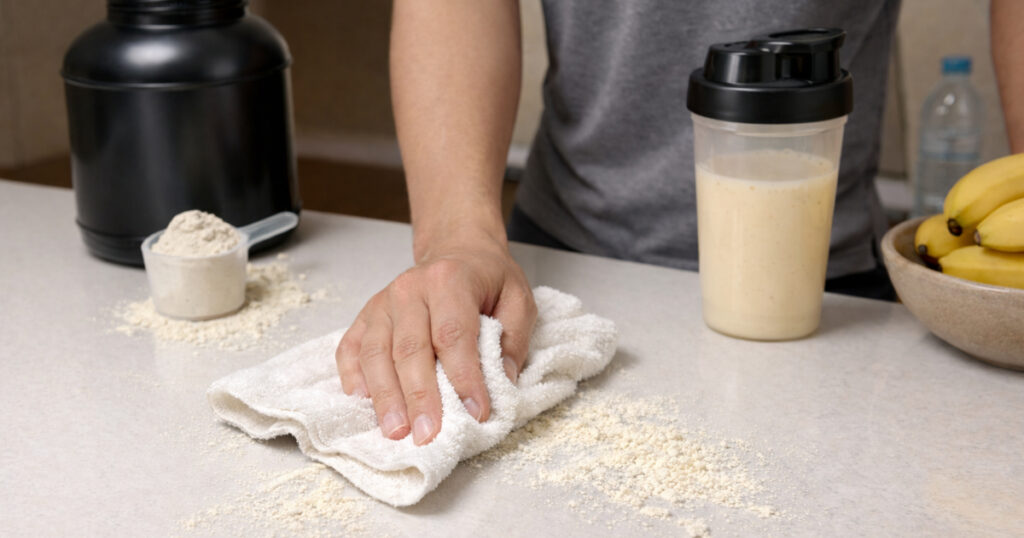
Spills don’t only happen when you pour into the shaker. From my own experience, there are three different moments where it goes wrong.
Pulling the scoop in and out of the bag
This one surprises people. You reach into the bag, dig around for the scoop that’s sunk to the bottom, then pull it back out through the opening. The bag’s edge catches powder and dusts the rim, and from there it sprinkles down.
With a 1 kg bag, the scoop sinks deeper as the bag empties. Eventually you’re up to your forearm in powder. By that point your hands are completely coated, so anything you touch next gets coated too, the shaker lid, the faucet handle, your phone. First thing in the morning, this wears on you in a way that’s hard to articulate but real.
Pouring into the shaker
Powder falls off the scoop on the trip to the shaker. If the shaker opening is narrow, more scatters in the moment you pour.
Whey particles are usually fine and stay airborne. The busier the morning, the sloppier the pour, and the worse the spill. Most people have lived this.
Resealing or transferring to a container
The bag’s zip seal getting jammed with powder is universal among protein drinkers. If you try to move the powder into a different container, the transfer itself becomes a spilling event. Narrow-necked containers guarantee a mess.
The reality is, anywhere you handle the powder, some of it ends up where it shouldn’t be. And “some” (repeated daily) adds up to a real source of stress.
Spills vs. Dirty Hands: Which One Is Actually Worse?
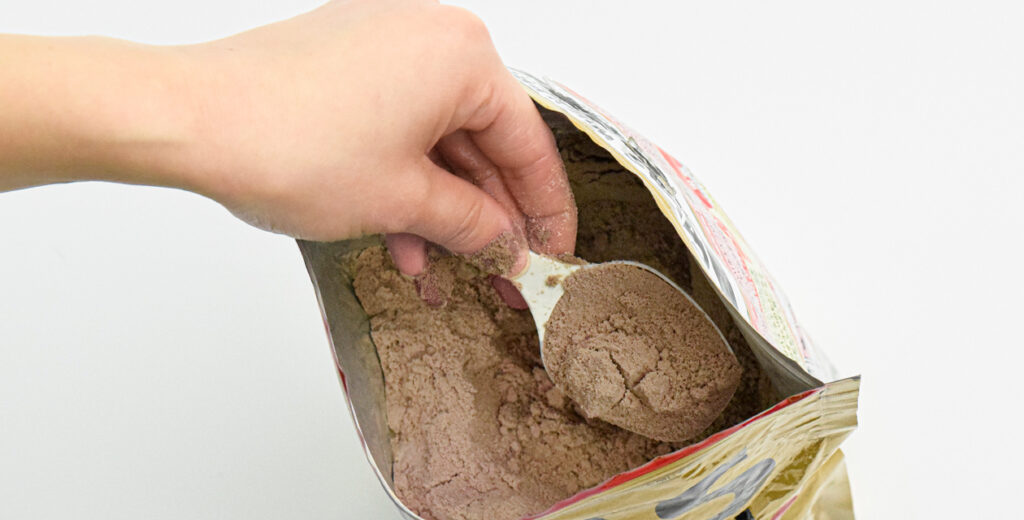
If I’m being honest, the part that bothered me most wasn’t the spilling on the counter. It was the powder on my hands.
Hunting for the scoop in the bag means your fingers are dusted before you’ve even started. From there, every action that follows is a little less pleasant. The faucet handle gets coated when you turn the water on. The shaker lid gets coated when you screw it shut. You wash your hands, then move to the next step. Every morning. Forever.
For a while I switched to measuring over the kitchen sink. Anything that fell down went straight to the drain. That actually solved the spill problem pretty well. The catch: my wife wanted the sink in the morning too. I got told the setup was in the way and had to retreat.
Spill management isn’t only about you. It’s about whoever else uses the kitchen.
Things You Can Try Right Now
With the causes mapped out, here are the fixes you can try today.
Check the shaker’s opening
Easy to overlook: the diameter of the shaker mouth. A wider opening dramatically reduces scatter when you pour. Anything 70 mm or wider is much more forgiving.
Level the scoop carefully
A heaping scoop is going to spill on the way over. A clean, leveled scoop, poured carefully, is faster overall and far less messy. The honest catch is that doing it carefully every single morning is, itself, kind of tedious.
Measure near the sink
This is what I used to do. Doing the scooping near the sink means anything that falls can be rinsed in seconds. Counter cleanup is a different category of pain. The downside, again, is that the kitchen is contested space in the morning.
Switch to a wider-mouth container
Moving from the zip bag to a wide-mouth container with a one-touch lid kills the jammed-seal problem. The transfer itself is a major spilling event, but it only has to happen once a month or so when you start a new bag. You take the hit once and live with it.
The Real Fix Is Changing the Measuring System
Everything above is about reducing how much spills.
But here’s the thing: as long as you’re scooping and pouring, spills aren’t going to zero. Neither are dirty hands. I tried all of these tactics, and what I kept landing on was “well, it spilled a little less today” and “still need to wash my hands.”
Eventually the answer became: don’t use a scoop at all.
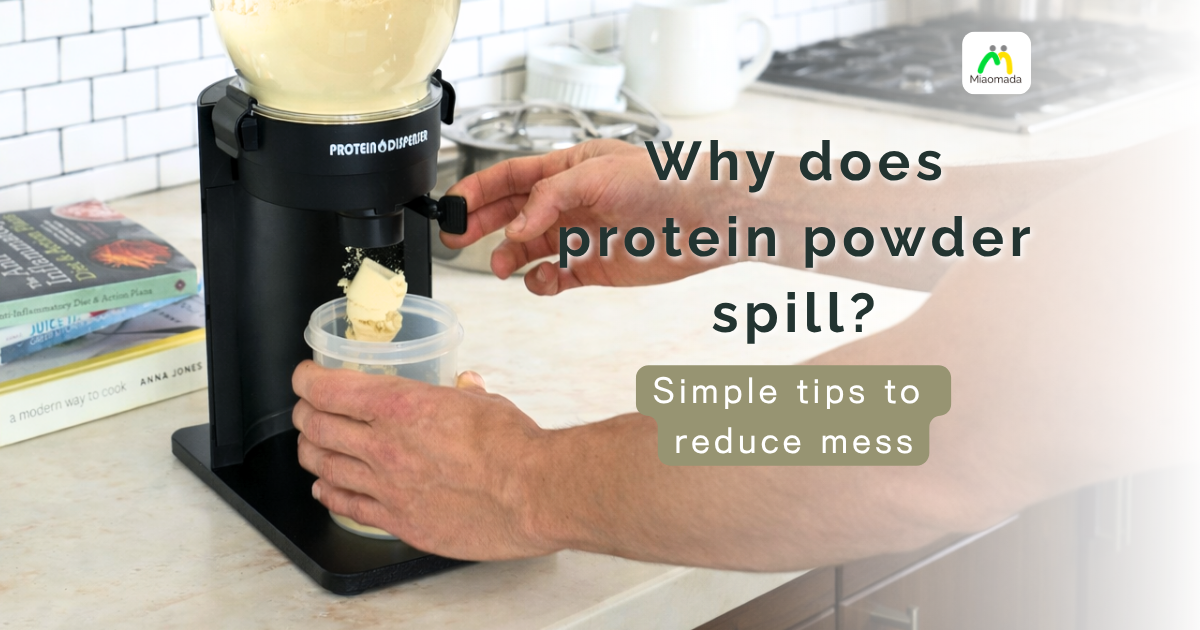
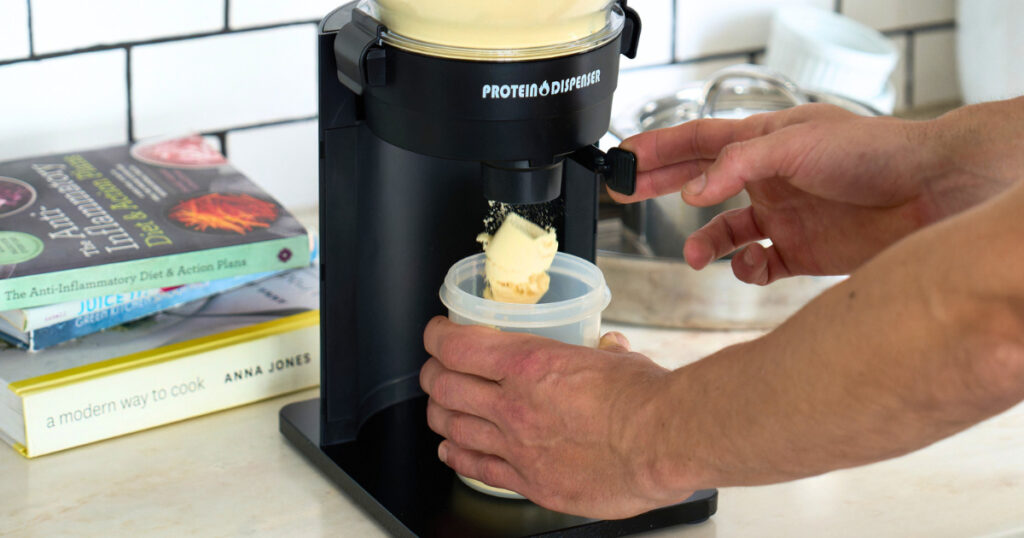
A protein dispenser handles storage and dosing in one unit. You pull a lever and the powder drops straight from the nozzle into the shaker. The whole “scoop and pour” stage just goes away.
Your hands never touch the powder. That was the part that got me. No reaching into the bag. No holding a scoop. Just pull the lever. Hands stay clean from start to finish.
The structural causes of spilling vanish too. The nozzle sits close to the shaker opening, so scatter is minimal. There’s no bag to open or reseal.
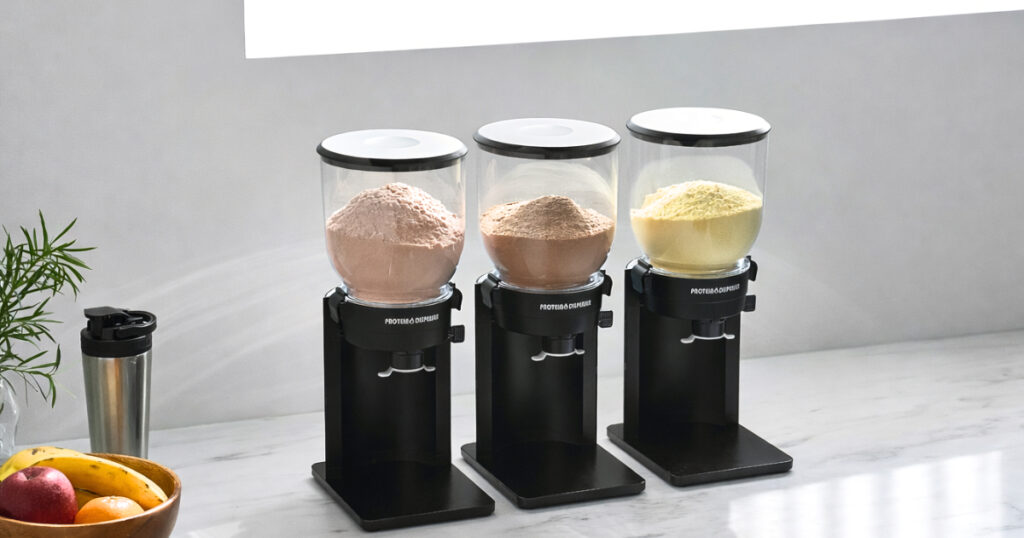
The ALENNE Protein Dispenser is a Japan-made unit built around a patented dosing mechanism. Each lever pull dispenses a consistent 10–15 g. It holds up to 1 kg, so once you transfer a bag in, you’re set for about a month. You can use it one-handed, which is what matters on a rushed morning.
For a broader picture of how the dispenser works and what it changes, see What Is a Protein Dispenser? How It Works and Why It Matters.
Spilling Is Not a Skill Issue. It’s a System Issue.
I don’t think protein spilling is something you “get better at.”
People who drink protein every day spill every day. Beginners spill. So do veterans. As long as you’re handling powder with a scoop, things will spill and your hands will be dirty. I scooped for over a year, and at the end of it I was still spilling and still bothered by powder on my fingers.
That’s why a system-level fix beats a willpower-level fix. Try the sink, try a new container, and if the friction is still there, change the measuring step itself. Removing one small irritation from your morning does more for protein consistency than people expect.

![What Is a Protein Dispenser? How It Works and Why It Matters [Complete Guide]](https://en.miaomada.co.jp/wp-content/uploads/2026/05/What-Is-a-Protein-Dispenser-768x403.png)

![Protein Dispenser Development Story [Part 1] — How DP-M1 Came to Be](https://en.miaomada.co.jp/wp-content/uploads/2026/05/004_hero_en-768x403.png)