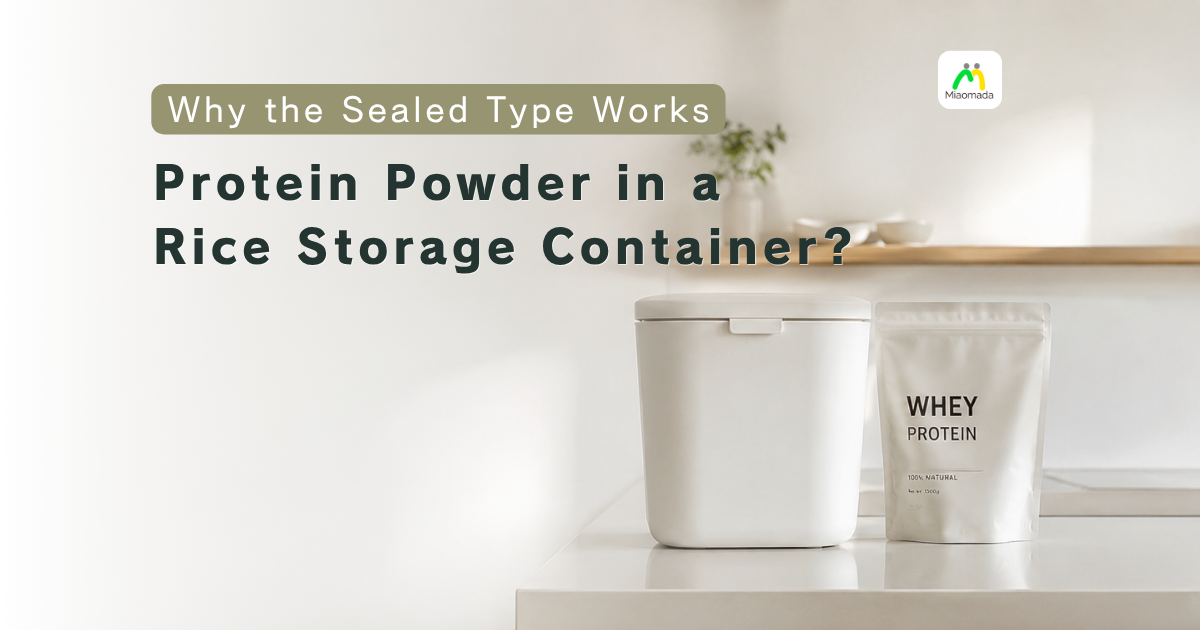
Can You Store Protein Powder in a Rice Storage Container? How It Differs From a Protein Dispenser
If you’ve been looking for somewhere to keep your protein powder, you may have landed on a rice storage container, the kind most Japanese households keep their rice in.
It’s big, it stands up to moisture, and a pull of the lever gives you a set amount. It looks like it could solve every protein storage headache in one go. And some people do keep their protein in one.
The catch is that “rice storage container” covers two different things. One works for storing protein powder. The other doesn’t.
Below, I’ll sort out whether protein belongs in a rice container, from the makers who went through 19 prototypes of a powder-dosing mechanism.
Can You Store Protein Powder in a Rice Storage Container?
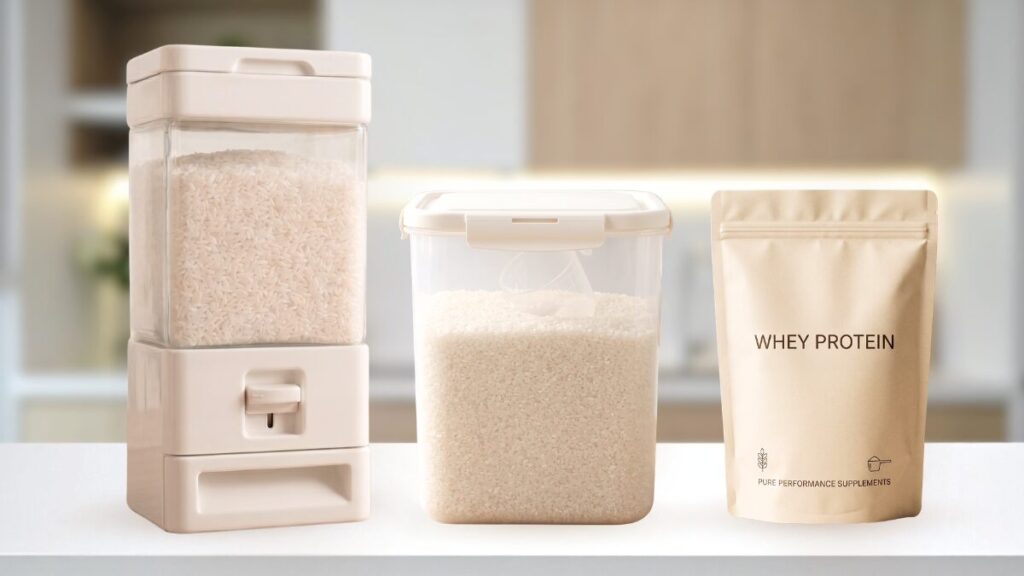
A sealed rice storage container, the gasket-lid box type, works for storing protein powder. A lever-type rice dispenser, the kind that measures out rice with a pull of the lever, does not.
What separates them is what the mechanism was built to do. The lever on a rice dispenser was built to drop rice, and nothing else. A rice grain is about 5 mm across, and grains roll past each other and fall without catching. Protein is a far finer powder, and it doesn’t fall the same way.
So a sealed rice container’s strength as a big box carries over to protein, while a rice dispenser’s measure-and-dispense mechanism does not.
Two Kinds of Rice Storage Container: Sealed Type vs Lever Type
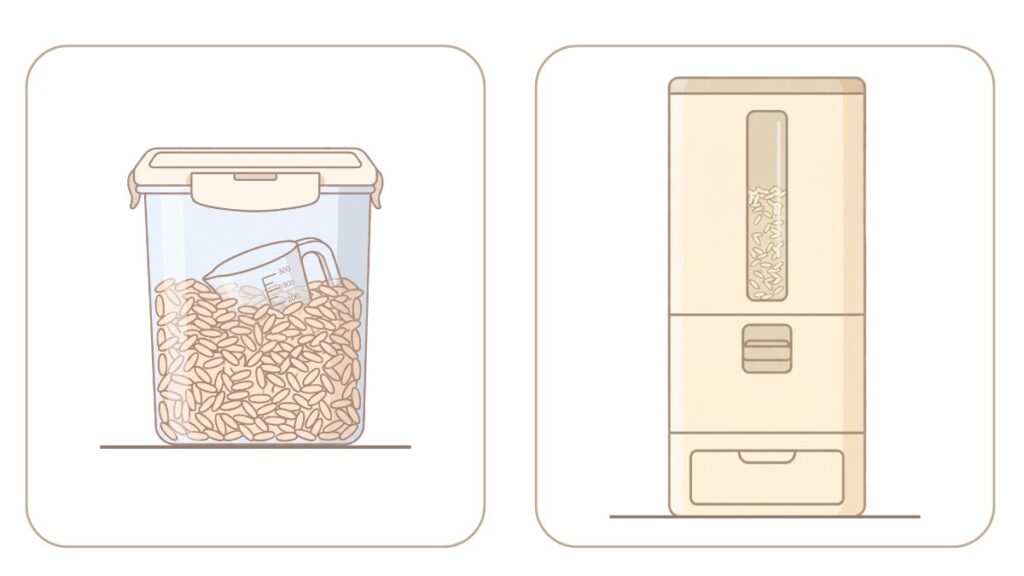
In Japan, where rice is bought in 5 kg bags (11 lb) and kept at home, products sold as rice storage containers split broadly into two kinds: the sealed type, built to keep moisture out, and the lever-type rice dispenser, which measures out one cup of rice per pull.
Search for one, and most of what comes up first is the sealed type.
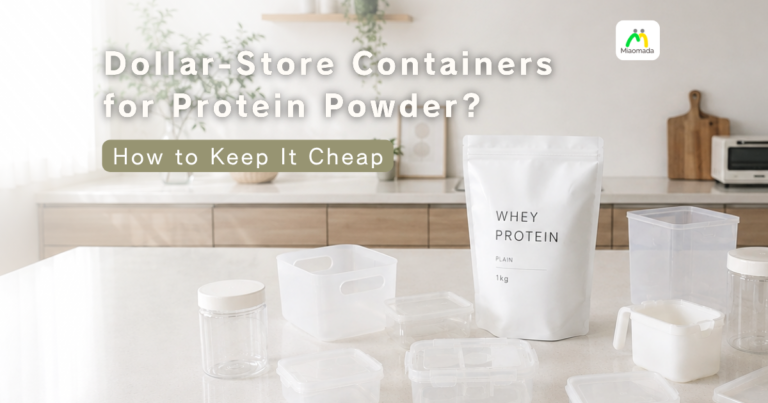
- Sealed rice storage container: A large storage box with a gasket and latches that keep moisture out. Some take the whole rice bag. There’s no measuring mechanism; you scoop with a cup or spoon. Think of it as a large gasket-lid food container and you have the idea
- Lever-type rice dispenser: Pull the lever, and one Japanese rice cup (about 180 ml, or 6 fl oz) comes out. The tall, narrow units that stand beside the fridge are the familiar kind in Japanese kitchens. This one has a measure-and-dispense mechanism
When this article says a rice container “works for storing protein”, it means the first kind, the sealed type.
For how to choose a protein container in general, I’ve compared the 4 main types in a separate article. A sealed rice container is a large version of what that article calls type 2, the food container with a gasket lid.
Why People Choose the Sealed Type: A 3 kg Bag Fits Whole
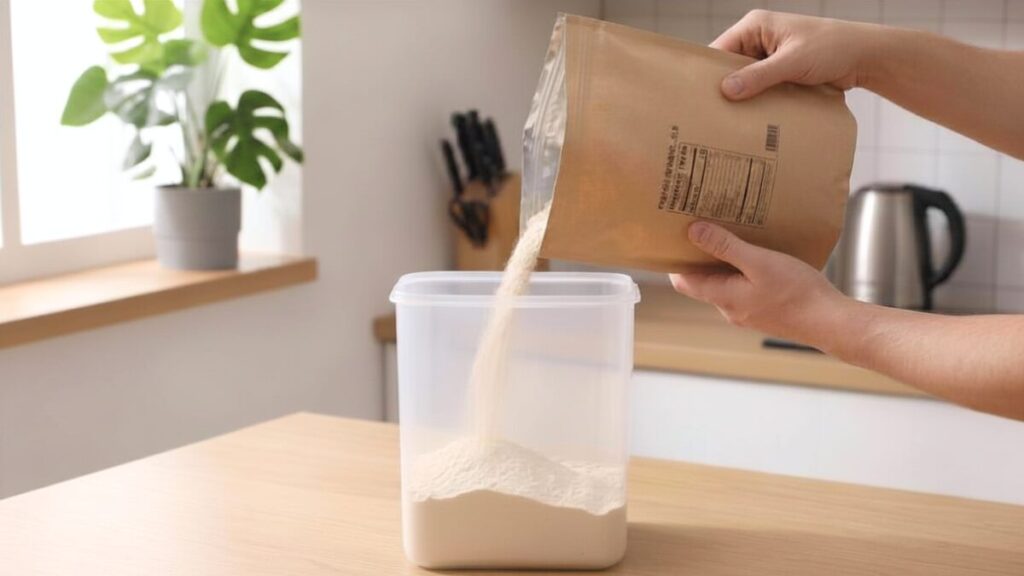
Rice containers are built to hold 5 kg of rice, so they’re big, and a 3 kg (6.6 lb) bag of protein fits inside whole. No other storage container does that.
Here’s something not many people know: protein powder takes up roughly twice the volume of the same weight of rice. Rice grains pack tightly; protein is a fine powder with air between the particles.
| Weight | Approximate volume | |
|---|---|---|
| Protein powder | 1 kg (2.2 lb) | about 2.4 L (2.5 qt) |
| Protein powder | 3 kg (6.6 lb) | about 7.1 L (7.5 qt) |
| Rice | 5 kg (11 lb) | about 6.3 L (6.7 qt) |
Rice comes in 5 kg bags as standard, so rice containers are made with a little room to spare, at around 7 L (7.4 qt). Loose and fluffy straight out of the bag, 3 kg of protein runs about 7.1 L. On the numbers alone, it looks like it won’t quite fit in a 7 L container.
Tap the container a few times, though, and the powder settles as the air escapes. One user reports getting 3 kg of protein into a 7 L sealed rice container by tapping the base to settle the powder as they went, with about 1 cm (under half an inch) to spare. How you pack it and which product you use both change the result, so it isn’t guaranteed, but a container sized for 5 kg of rice may well take a 3 kg bag of protein whole.
Most containers sold specifically for protein are sized around 1 kg, too small for anyone buying 3 kg bags. It makes sense that the more you buy in bulk, the more likely you are to end up with a rice container.
Why Doesn’t a Lever-Type Rice Dispenser Work for Protein?
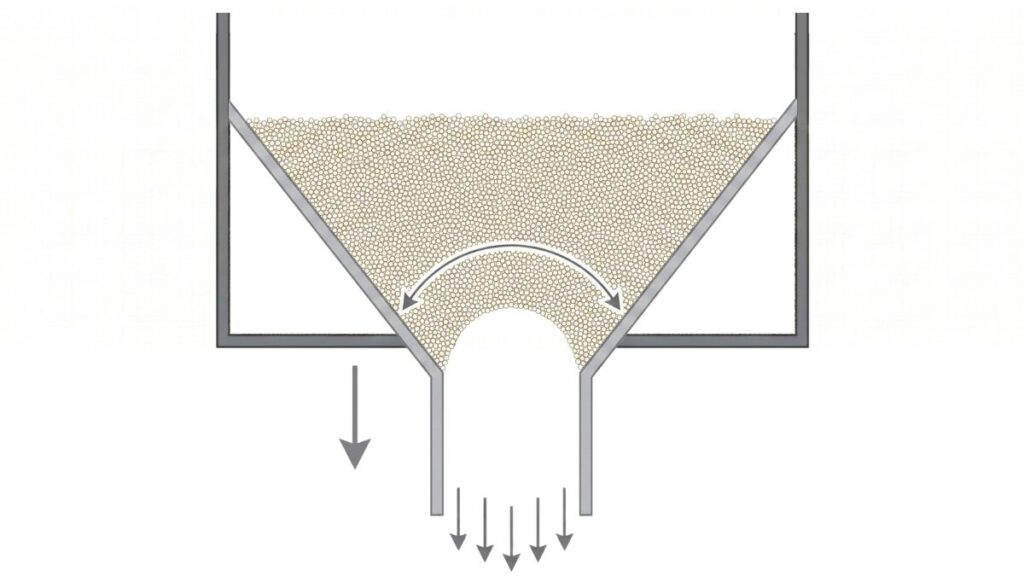
Because its lever was built to do one thing: drop rice. Even a free-flowing protein powder tends to catch instead of falling through.
The first thing to know is that protein powders differ from product to product. Some cling to your hand; some run as freely as sugar. They aren’t all the same sticky powder.
Even so, put a free-flowing protein into a rice dispenser, and it won’t fall properly. The powder is a different size and shape from a rice grain, and the gaps and passages built for rice won’t simply let it through.
And it gets worse over time.
It starts to clump once it absorbs moisture
A protein that started out free-flowing begins to stick to itself once it takes on moisture. The powder then forms a bridge, an arch over the outlet with empty space underneath, and nothing comes down. Rice grains almost never do this. It’s why protein cakes so readily in humid weather (Japan’s rainy season is the worst stretch).
It works its way into small gaps
A lever mechanism has small gaps at its moving parts. Rice grains are too big to get in; protein isn’t. Powder that gets in makes the action stiff and slows the lever’s return.
It can’t be washed
And this is what settles it. A rice dispenser isn’t built to be taken apart and washed. With rice, a dry grain, that’s not much of a problem. Protein contains fat. Powder that has worked into the mechanism can’t be taken out or rinsed out, so it stays there.
Which means a rice dispenser, even if it dispensed well at first, isn’t suited to long-term use. You’d be adding fresh powder on top of old powder that never leaves.
When we built our protein dispenser, this was the part that took the longest. To make “a set amount, without jamming, the same every time” work, we went through 19 prototypes of the dosing mechanism alone. I’ve written that process up in 19 Prototypes to a Dosing Mechanism: The Engineering Behind the Protein Dispenser. The mechanism we ended up with is registered as Japan Patent No. 7580860.
It’s no surprise that a mechanism built to move rice doesn’t simply work with protein. This powder was never part of the design.
Even With the Sealed Type, Hands Touch the Powder
The sealed type works for storing protein, but your hand or a spoon touches the powder both when you fill it and when you scoop from it. Touch the powder, and oils from your skin can transfer to it.
When protein storage comes up, “sealed” is the first word people reach for. And yes, keeping moisture out matters. But even with the powder in a sealed container, you open it every day, push a spoon in, scoop, and close it again. Each time, outside air gets in, and your hand or the spoon touches the powder inside.
The touching is the part that gets overlooked. If a hand or spoon touches the powder, skin oils transfer to it. What really concerns me, though, isn’t the oil itself so much as bacteria getting in from your fingers. Restaurants use gloves or tongs rather than bare hands. I take it they’re avoiding what passes from hands to food, and I feel the same about a powder I put in my mouth every day. Hands touch all sorts of things over the course of a day. Bring that hand near the powder every time you scoop, and whatever was on it moves into a powder you’ll keep eating for weeks.
Whether it seals is a separate question. Open, spoon in, scoop, close. Each time, what was outside gets into the powder inside. I’ve written about why sealing isn’t all that matters in storage in What Actually Matters in Protein Storage Wasn’t “Sealing It Tight”.
If you’re going to use a sealed rice container for protein, checking these points makes it less likely to go wrong:
- Does it have a gasket? A lid that simply rests on top won’t keep moisture out fully
- Is the opening wide? This matters in two ways. A narrow opening is awkward to get a spoon into, and it makes spills more likely when you transfer a 3 kg bag. If you spoon it in a little at a time to avoid spilling, your hand gets that much closer to the powder, and skin oils have more chances to transfer. An opening wide enough to pour the bag straight in cuts both the spills and the skin contact at filling time
- Is the capacity right? For a 3 kg bag, a container sized for 5 kg of rice (around 7 L) is the guide
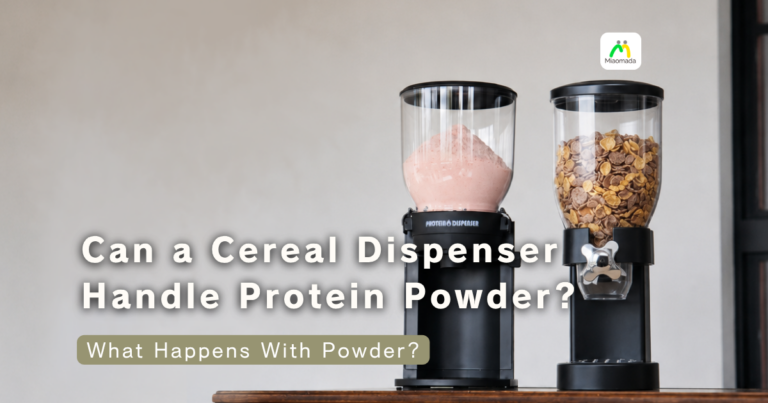
The Other Option: A Dispenser Built for Protein
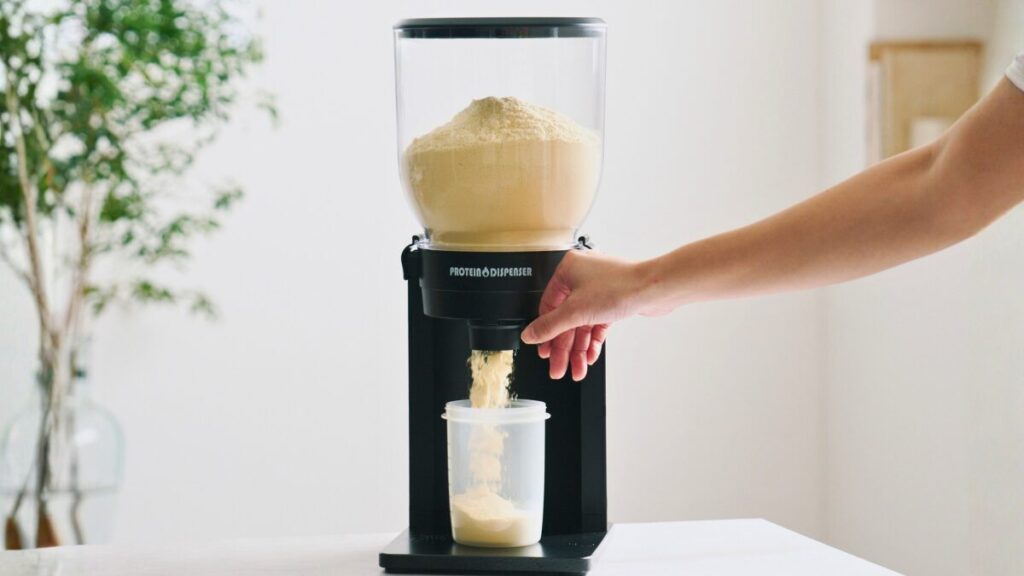
This is a tool whose dosing mechanism was designed around protein from the start. Pull the lever, and a set amount comes out; your hands never touch the powder.
We built the ALENNE Protein Dispenser to make “pull the lever, get a set amount” work for protein. Hunting for the scoop every morning, reaching into the bag, spilling, wiping up. Wanting to stop that cycle is where it started.
- A set amount comes out: One pull of the lever dispenses a consistent dose. No scoop to hunt for
- Hands never touch the powder: There’s no scooping, so your hands touch neither the powder that comes out nor the powder still inside
- No skin oils get in: If hands don’t touch the powder, skin oils can’t transfer to it
- It comes apart for washing: This is the decisive difference from a rice dispenser. The tool handles a powder that contains fat, so it’s designed to be washed. We recommend washing it each time you finish 1 kg
The one we value most is the third. With no scooping, whatever was on your hands doesn’t get into the powder you’re storing. Skin oils stay out, but more than that, it avoids bacteria getting in from your fingers, and I think that’s the bigger gain. It isn’t built to seal the powder in, but what it gives up in sealing, we think it may make up in keeping the powder inside clean. For a powder you’ll keep eating for weeks, I think that’s where it counts.
In Summary: The Sealed Type Works for Storage, the Lever Type Doesn’t
Can you store protein powder in a rice storage container? The answer: the sealed type works for storage, and the lever-type rice dispenser doesn’t.
- A sealed rice storage container works for storing protein. It’s sized for 5 kg of rice (around 7 L), so a 3 kg bag fits whole
- A lever-type rice dispenser doesn’t work for protein. Its mechanism was built only to drop rice, and even a free-flowing powder catches in it
- On top of that, a rice dispenser can’t be taken apart and washed. It isn’t suited to holding a fat-containing powder like protein over the long term
- Even with the sealed type, your hands touch the powder when you fill it and when you scoop, so skin oils can still transfer
- If keeping hands off the stored powder is the point, a protein dispenser is the better fit. Its hopper is designed to come apart for washing each time you finish a bag
Related reading:
- What Actually Matters in Protein Storage Wasn’t “Sealing It Tight”
- 19 Prototypes to a Dosing Mechanism: The Engineering Behind the Protein Dispenser
The ALENNE Protein Dispenser
The ALENNE Protein Dispenser is Miaomada’s flagship product: pour straight from the bag or tub into the hopper, slide the lever to measure a set dose, and keep it on the counter as part of your daily routine.
Its dosing mechanism was built for fine powder rather than rice grains, and it comes apart for washing. If a set dose with your hands off the powder is what you want from a container, that pair is what it was designed for.