How to Spend Less on Protein Powder: What Works Now That the Raw Material Costs 3 Times More
Protein powder has gotten expensive, and the numbers back that up. Japan’s import data puts the average price of the raw material at ¥746 per kg (about US$5) in January 2021 and ¥2,234 per kg (about US$15) in January 2026, roughly 3 times as much. The weak yen is part of the Japanese figure, but the price of whey itself rose worldwide, so the direction is the same wherever you buy.
And this level is going to hold for a while. For the raw material to come down, dairy production has to catch up, and in Japan the earliest that’s expected is the second half of 2027. “It’ll drop eventually, so I’ll wait” is hard to make work, to be honest. The background is in a separate article on why protein powder got so expensive.
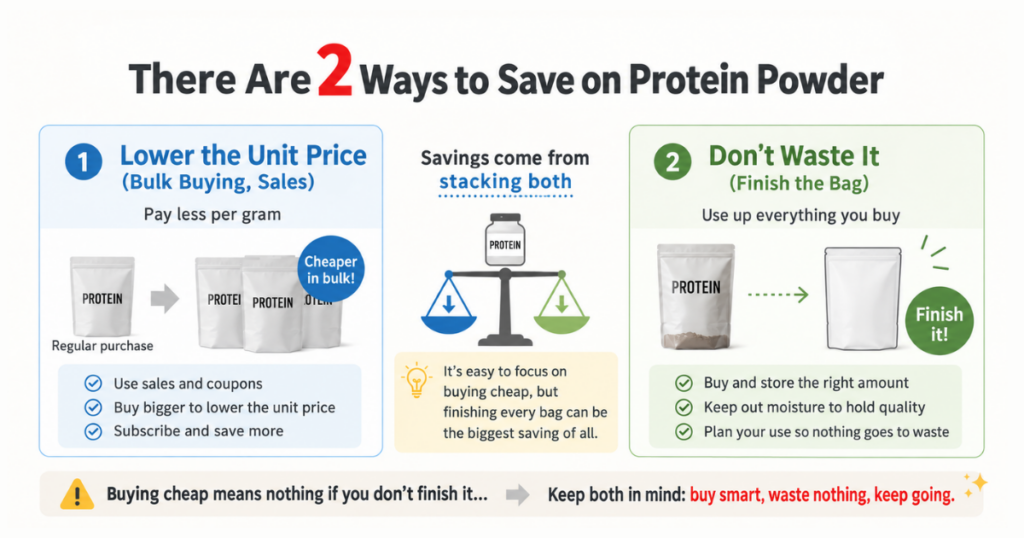
Waiting isn’t the only move, though. The savings come from 3 places: how you buy, what you choose, and how you use what you bought.
Where Can You Cut the Cost of Protein Powder?
In 3 places: how you buy, what you choose, and how you use it. They differ in how much they save and how much effort they take, so start with whichever one you can actually do.
| Approach | What to do | How it saves |
|---|---|---|
| Buying | Bigger bags, sale timing | Lower price per kilogram |
| Choosing | WPC over WPI, powder over bars and drinks | Lower price per gram of protein |
| Using | Finishing every bag | No money thrown out |
The first two are about buying cheaper. The third is about not throwing it out. Skip the third, and the math stops working, so I’ll come back to it in the second half.
How Much Does Buying in Bulk Save?
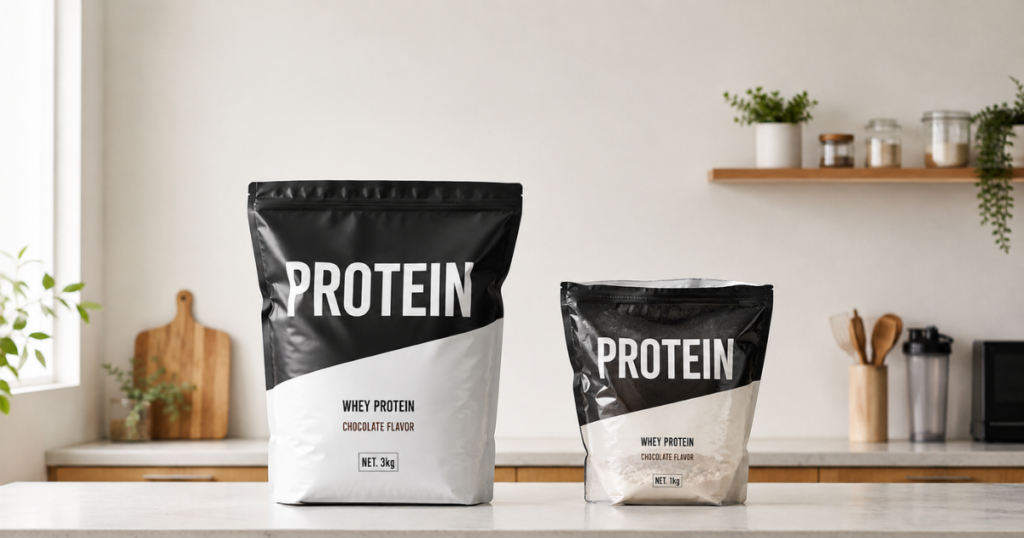
As a rule, the bigger the bag, the lower the price per kilogram. Whether that helps you depends on whether you can get through it.
A 3 kg bag (6.6 lb) usually costs less per kilogram than a 1 kg bag (2.2 lb), and 5 kg (11 lb) less again. It’s a straightforward saving, so it’s worth looking at first.
The catch is that a lower price per kilogram means nothing if you don’t finish the bag. Once protein powder is opened, its quality from that point depends on where you keep it and how you use it. I’ve covered that in Protein Powder Shelf Life and the Signs It’s Gone Off, and the usual guideline is to finish an opened bag within 1 to 3 months.
Count how many grams you get through in a month, and the right size picks itself. At 30 g a serving (about 1 oz), 5 days a week, that’s about 600 g a month (about 1.3 lb). Buy a 5 kg bag at that pace, and it takes 8 months to empty. The unit price is lower, but by the back half you may be drinking powder that’s past its best.
WPC or WPI: Which Is Cheaper?
WPC is generally the cheaper of the two. It goes through fewer processing steps, and the price reflects that.
Whey protein comes in 2 broad forms: whey protein concentrate (WPC) and whey protein isolate (WPI). WPI is refined further to raise the protein purity, and it usually costs more as a result.
If cost comes first, WPC is the default choice.
One exception: if milk tends to upset your stomach, don’t decide on price alone. Milk contains a sugar called lactose, and the ability to break it down is said to vary from person to person. When it isn’t fully broken down, it can show up as digestive trouble. WPI is said to have less lactose because of how it’s processed, so if that’s a concern for you, there’s a reason to choose WPI.
If that’s never been an issue for you, it’s fine to choose on price.
Do Bars and Drinks Cost More Than Powder?
Per gram of protein, powder is generally the cheapest, with bars next and ready-to-drink shakes above that.
A carton shake or a protein bar is ready the moment you open it. That processing and packaging gets added to the price. You’re paying for convenience, so the premium is fair enough, but cover your daily intake this way, and the difference adds up over a month.
Keeping bars on hand for when you’re out makes sense. Using them for what you drink at home as well pulls in the other direction. It’s about matching the form to the situation.
How Should You Use Sales?
Stacking a sale on top of a bigger bag saves the most. Brands that sell direct online, in particular, tend to discount more heavily at certain times of year.
Discount rates change from one sale to the next, so I won’t put numbers here. What matters is how you combine them.
- Go one size up during a sale, within what you can finish: the two discounts stack
- Don’t wait until you’ve run out: once the bag is nearly empty, there’s no room to wait for a sale. Keep a month’s supply in reserve, and you get to choose on price
In other words, whether you can take advantage of a sale comes down to managing your stock.
How Much Does It Actually Save, and How Do You Work It Out?
Compare cost per serving. The formula is price of the bag ÷ (grams in the bag ÷ grams per serving). It’s the only way to put products of different sizes and prices on the same footing.
Comparing is tricky because both the bag size and the serving size differ from product to product. Comparing bag prices tells you nothing.
At 30 g per serving, it works like this:
- A 1 kg bag at US$30: 1,000 ÷ 30 ≈ 33.3 servings. 30 ÷ 33.3 ≈ US$0.90 per serving
- A 3 kg bag at US$78: 3,000 ÷ 30 = 100 servings. 78 ÷ 100 = US$0.78 per serving
That’s a difference of about US$0.12 per serving. It looks small, but 5 days a week for a year (about 260 servings) comes to roughly US$31. Bulk buying shows its value once you look at it per year.
These figures are examples to show the steps, not the prices of real products.
And there’s one more step to the calculation. The denominator is the servings you actually drank, not the servings you bought. Buy the 3 kg bag planning on 100 servings, throw it out after 80, and the cost per serving climbs back to about US$0.98. Finishing the 1 kg bag would have been cheaper.
What Gets Overlooked? Not Wasting a Bag
This is the piece that slips through most often. At today’s prices, throw out a bag you couldn’t finish, and you lose in one go everything your smarter buying saved.
Most articles on saving money stop at how to buy cheaper. Once you count how much of what you paid for you actually drank, the picture changes.
One thing to keep straight: the raw material tripled, but shelf prices in Japan didn’t. Manufacturers there have absorbed a good part of it, including by adjusting bag sizes. Even so, a bag you could shrug off a few years ago now costs enough that the shrug doesn’t come as easily.
The typical ways a bag goes to waste:
- Bought the big size because it was cheaper → moisture or discoloration set in before it was finished, and the rest went in the trash
- Hit a busy stretch and stopped drinking it → the date had passed by the time you noticed
- No idea when it was opened → couldn’t tell whether it was still fine, so it got tossed just in case
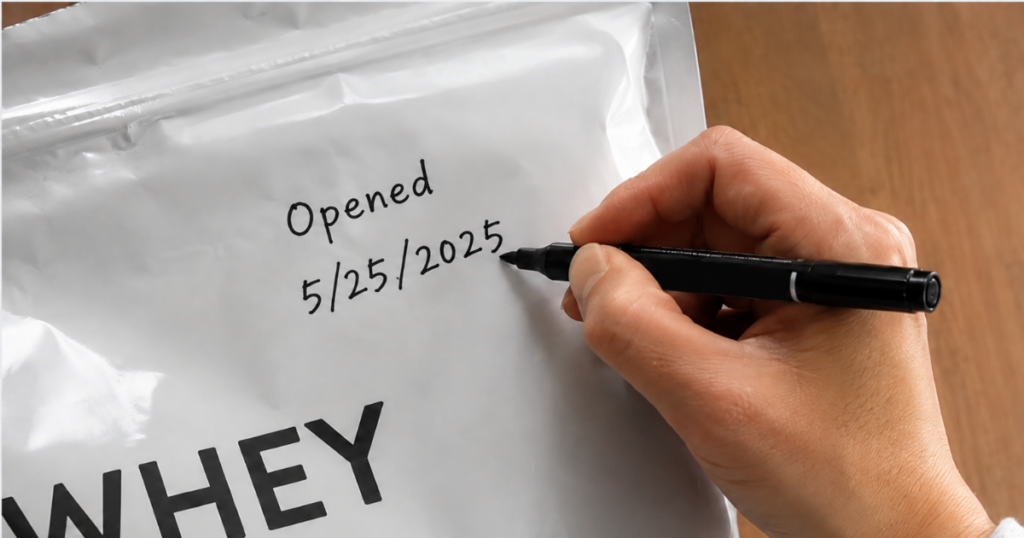
None of these is fixed by how you buy. What works is buying an amount you can finish, writing the opening date on the bag, and keeping your routine in a shape you can actually stick to. Unglamorous, but the money involved can be bigger than any bulk discount.
Choosing on Price Alone Can Cost You
If you don’t keep drinking it, it ends up the most expensive option of all. Price is one criterion, not the only one.
Pick purely on price, and this is what tends to happen: the flavor isn’t for you, or it doesn’t mix well and drinking it becomes a chore. A bag you stop drinking is wasted in full for every serving you skipped, however low the cost per serving was.
Comparing cost per serving works. Weigh it against whether you’ll actually keep drinking it before you decide. Something a little more expensive that you drink every day often works out cheaper in the end.
In Summary: Buy Smarter, Then Don’t Waste It
- The average import price of the raw material in Japan roughly tripled in 5 years. That level is expected to hold in Japan until at least the second half of 2027, so a plan built on waiting is shaky.
- Buying: bigger bags tend to cost less per kilogram, and stacking a sale on top saves more. Decide by whether you can finish it.
- Choosing: WPC is generally cheaper than WPI. Powder is the cheapest form; bars and drinks cost more for the processing.
- Using: waste one bag, and you lose everything your buying saved in one go. At today’s prices, throwing out a bag hurts far more than it did a few years ago.
- Keep a month’s supply in reserve, and you can wait for a sale. Using sales comes down to managing your stock.
- Choose on price alone, stop drinking it, and it becomes the most expensive option. Multiply cost per serving by whether you’ll keep it up.
Related reading:
The ALENNE Protein Dispenser
The ALENNE Protein Dispenser is Miaomada’s flagship product: it stores protein powder and measures it in one unit. The dosing mechanism alone went through 19 prototypes and is registered as Japan Patent No. 7580860, with a patent pending in the U.S.
Pour straight from the bag or tub into the hopper, slide the lever, and one serving comes out without your hands touching the powder. If you’d like daily measuring and that kind of hygiene handled together in one simple step, it’s worth a look.