Why Did Protein Powder Get So Expensive? Behind the 3x Rise in 5 Years
“Protein’s gotten expensive, hasn’t it?” I’ve heard that a lot over the past year, and the price really has kept climbing.
Why did it go up? When will it come back down? And now that it has gone up, what can we do about it? This article works through those 3 questions using publicly available primary data. The numbers are from Japan, where I’m based, but the raw material half of the story is global (whey is a worldwide commodity), and the currency half is the Japan-specific layer on top.
We don’t make protein; we make a tool for handling it. So I’m not going to tell you which brand is cheapest. What I will do is follow the price rise all the way down to what it changed in daily use.
Why Did Protein Get More Expensive?
Because the global price of whey, the raw material, rose at the same time the yen weakened. In Japan, the average import price roughly tripled in 5 years.
Most of the protein sold in Japan is made from imported ingredients. That means the price is set by two things multiplied together: what the raw material costs overseas, and the exchange rate at the time. Over the past 5 years, both moved in the same direction. Whey went up, and the yen fell alongside it. Either one on its own might have been a gap manufacturers could absorb. Both arriving together was more than they could take on, and it showed up on the shelf. That’s the broad picture.
What matters here is that this isn’t a temporary shortage or a logistics snag. What moved are the two things no manufacturer can control: the commodity price and the exchange rate.
How Much Did It Rise? About 3x in 5 Years
The average import price went from ¥746 per kilogram (about US$5) in January 2021 to ¥2,234 (about US$15) in January 2026, close to 3 times higher. That’s an increase of ¥1,488 per kilogram (about US$10).
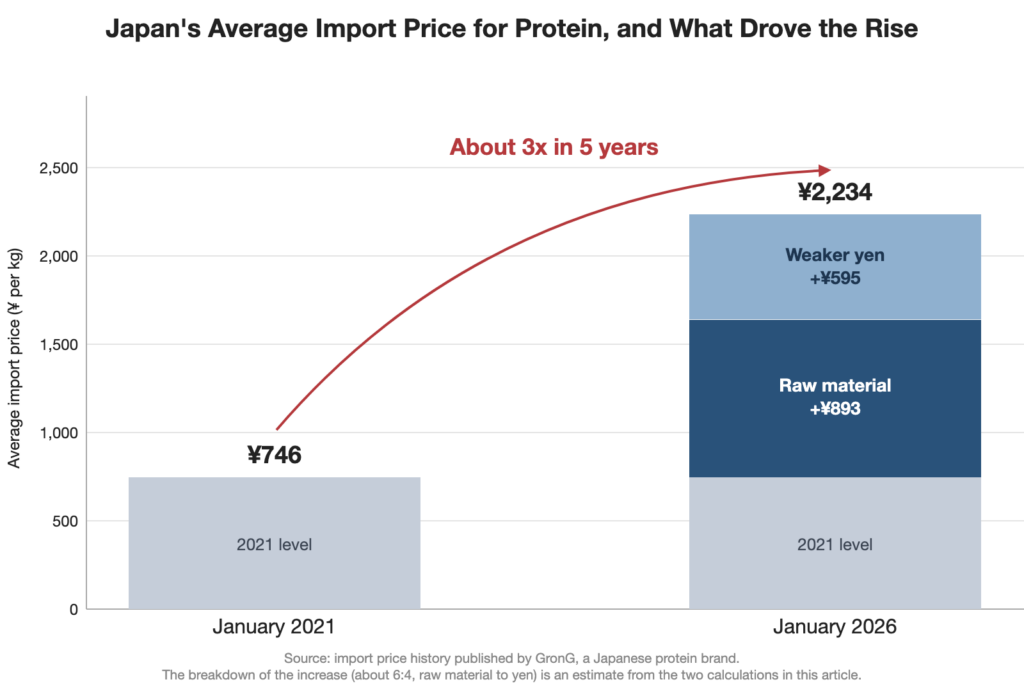
The figures come from the import price history published by GronG, a Japanese protein brand.
I built the article around this series because it’s primary data in yen, and it doesn’t mix grades. Pull up an overseas spot price, and the numbers look more dramatic, but they blend coarse industrial grades with the refined grades used in finished products, so the comparison falls apart. Here I’m looking at one thing only: what the whey that actually arrived in Japan cost.
Store prices, on the other hand, haven’t risen the same way. Going by what the manufacturers themselves have published:
- One major Japanese manufacturer’s flagship whey protein (980 g, about 2.2 lb) rose about 30.5% per kilogram between June 2022 and July 2026
- The same manufacturer cut the bag from 1,050 g (about 2.3 lb) to 980 g in June 2022 and held the price. Per kilogram, that works out to a real increase of about 7.1%
- Another major manufacturer raised its suggested retail price by about 4.5% in April 2023
The raw material is up about 3x, yet the shelf price is up only about 1.3x. As I read it, that gap is what the manufacturers have absorbed, through package size changes and a good deal of effort besides. Before passing a price rise on, they took on as much as they could themselves. That’s why what we pay at the register has stayed within this range.
Raw Material or the Weak Yen: Which One Matters More?
Roughly 60% raw material, 40% yen. Two separate ways of calculating it landed on almost the same split.
To check the breakdown, I ran the numbers two independent ways.
1. Take the yen import price and back out the exchange rate: 62% raw material, 38% yen 2. Take the European price in euros and multiply by the euro-yen rate: 58% raw material, 42% yen
Two different approaches, and both landed near 6:4. The exact figures shift with the assumptions, but the conclusion holds either way: the raw material is the slightly bigger factor, and the yen can’t be ignored.
This means that even if the yen strengthens again, only about 40% of the increase comes back. Unless whey itself comes down, prices don’t return to where they were.
Is It True That GLP-1 Weight-Loss Drugs Drove the Price Up?
It gets said a lot, but the numbers don’t back it up. The manufacturers themselves, the people closest to it, aren’t giving that explanation.
Search the topic, and you’ll keep finding the same story: GLP-1 receptor agonists (the weight-loss drugs) went mainstream, protein demand surged, and whey prices took off. AI summaries serve it up as the answer too. It sounds plausible, and I took it at face value at first. Once I dug in, though, it looked different.
For a start, the large overseas producers of whey ingredients don’t cite GLP-1 when they explain why demand is strong. They acknowledge whey is selling well, but they don’t attribute it to weight-loss drugs. If it really were the main driver, you’d expect it to be the first thing they mentioned. The big brands that sell finished protein products do touch on it, but they go no further than calling it one tailwind among several.
Then there’s the question of scale. The share of people on these drugs has a ceiling, and even if every one of them drank more protein, the effect on total whey demand would be small. As an explanation for a raw material tripling, it’s off by an order of magnitude.
So GLP-1 isn’t zero, but it isn’t the main cause. The main causes are the ones above: the commodity price and the yen.
I think this is an example of how a plausible story, once it spreads, becomes accepted fact even when the people involved never said it. The only way to check is whether the numbers add up.
When Will Prices Come Back Down?
Not before the second half of 2027, even on an optimistic view. In practical terms, plan on this level holding for another year and a half or so.
For the commodity price to reverse, dairy production needs to rise and supply needs to loosen. Building up herds and getting milk output up takes years, so this isn’t the kind of thing that snaps back next month or next quarter. The exchange rate can move, but as we saw, that recovers only about 40% of the rise.
Honestly, “it’ll come down eventually, so I’ll wait” is hard to justify right now.
What the Price Rise Really Changes: Finishing Every Bag
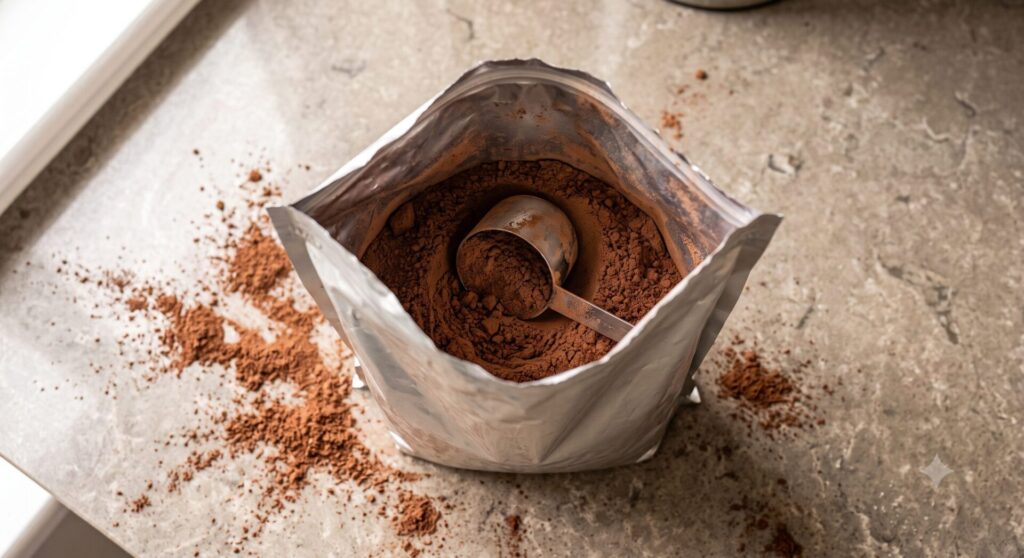
A bag costs more now, so a bag that goes to waste hurts more than it used to. How you use a bag up matters more than how you shop for it.
Hunting for cheaper protein, buying in bulk, waiting for sales: all of them work, but with whey at 3x, there’s a limit to how much difference shopping can make.
Here’s the part that doesn’t get talked about much. Are you getting through each bag you buy, with the quality intact, all the way to the end?
Left open, spilled, clumped and thrown out, past the date and still sitting there. None of these stung much before. Now they do. It’s the same waste, but a different amount of money. Here’s what makes a difference:
- Keep moisture out: open and close it less often, and keep it somewhere dry (see What Actually Matters in Protein Storage Wasn’t “Sealing It Tight”)
- Stop the spills: scoop straight from the bag, and you lose more than you’d think (see The Protein Spill Problem: Let’s End It)
- Use it up before the date: know how the powder changes once it’s open (see Protein Powder Shelf Life and the Signs It’s Gone Off)
- Pick the right container: match the container to how you actually use it
What a Tool Can Do About It
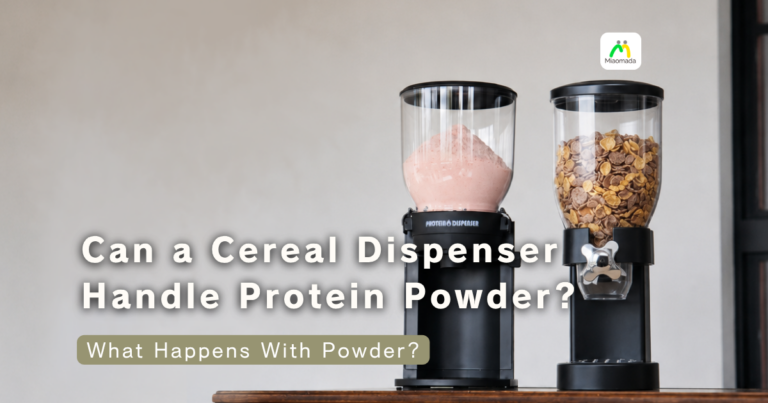
A protein dispenser is a tool for dispensing a set amount of powder without your hands touching it. It cuts down on spills and on how often you open and close the bag.
Our ALENNE Protein Dispenser delivers a set dose when you push the lever. We didn’t build it as an answer to rising prices, but it does end up helping you use every bag with nothing wasted. The hopper isn’t built to seal the powder in, though. It’s a tool for making daily dosing easier and cleaner, not a container for long-term storage, so the realistic setup is to pair it with a container that’s suited to storing.
In Summary: Prices Won’t Come Back Soon, but Waste Is Yours to Cut
- Japan’s average import price for protein roughly tripled between January 2021 and January 2026. The causes are the global whey price and the weaker yen, at a split of about 6:4
- The common claim that GLP-1 weight-loss drugs are the main cause isn’t supported, either by what the industry itself discloses or by the scale involved
- A reversal isn’t expected before the second half of 2027 at the earliest. Plan on the current level holding for another year and a half or so
We can’t do anything about the price. What we can do, starting today, is make sure nothing we’ve paid for goes to waste.
Related reading:
- What Actually Matters in Protein Storage Wasn’t “Sealing It Tight”
- The Protein Spill Problem: Let’s End It. Every Cause, Every Fix, in One Place
- Protein Powder Shelf Life and the Signs It’s Gone Off
The ALENNE Protein Dispenser
The ALENNE Protein Dispenser is Miaomada’s flagship product: pour straight from the bag or tub into the hopper, slide the lever to measure a set dose, and keep it on the counter as part of your daily routine.
We didn’t design it as a response to rising prices. But the patented dosing mechanism measures a consistent dose with each pull of the lever. There’s no scoop and less powder scattered on the counter, and that’s most of what it takes to finish a bag or tub with nothing wasted.