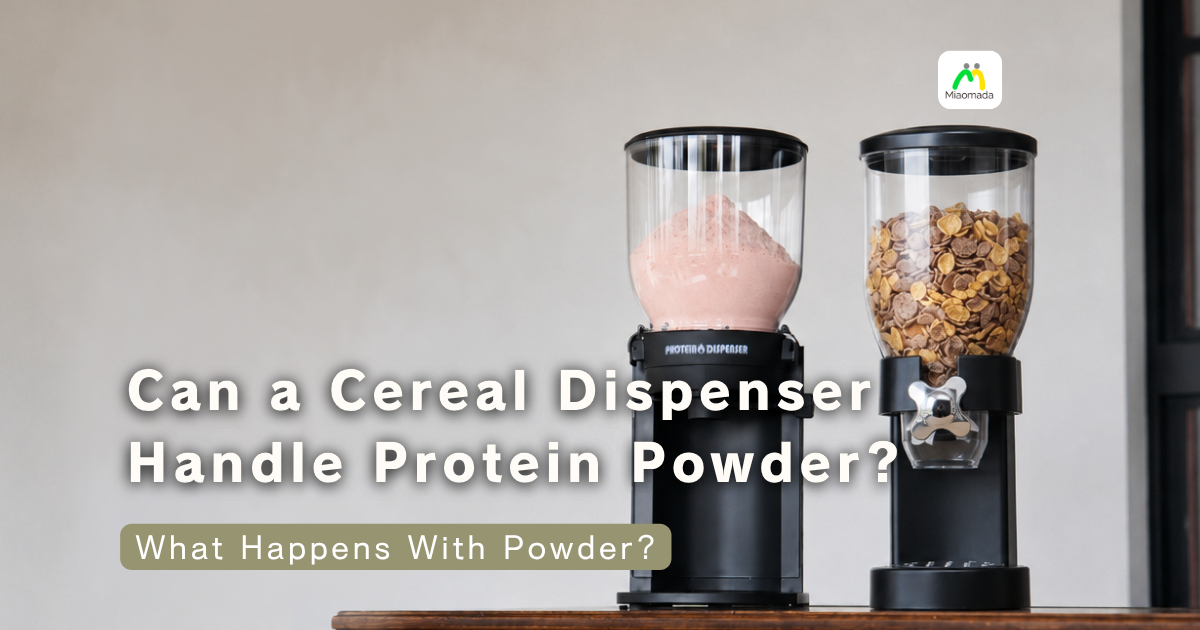
Cereal Dispenser or Protein Dispenser? They Look Alike, but the Insides Are Built for Different Things
Go looking for a container that turns storing and measuring protein powder into one job, and cereal dispensers come up. A clear hopper on a black body, and a turn of the handle drops a set amount. Some of them look and move almost exactly like a protein dispenser.
And because they look so alike, some people get stuck right there. One is affordable, the other isn’t. If they look the same, why the gap? That’s the moment you think “that much?”, and your hand stops.
The short answer: the outside is similar, but the dosing mechanism inside is a different thing. A cereal dispenser is built to move pieces. Protein is a powder too, but it’s a fine powder, and fine powder doesn’t behave like cereal.
Below, why a protein dispenser that looks identical to a cereal dispenser is a different tool, from a maker that has gone through 19 prototypes of its powder dosing mechanism.
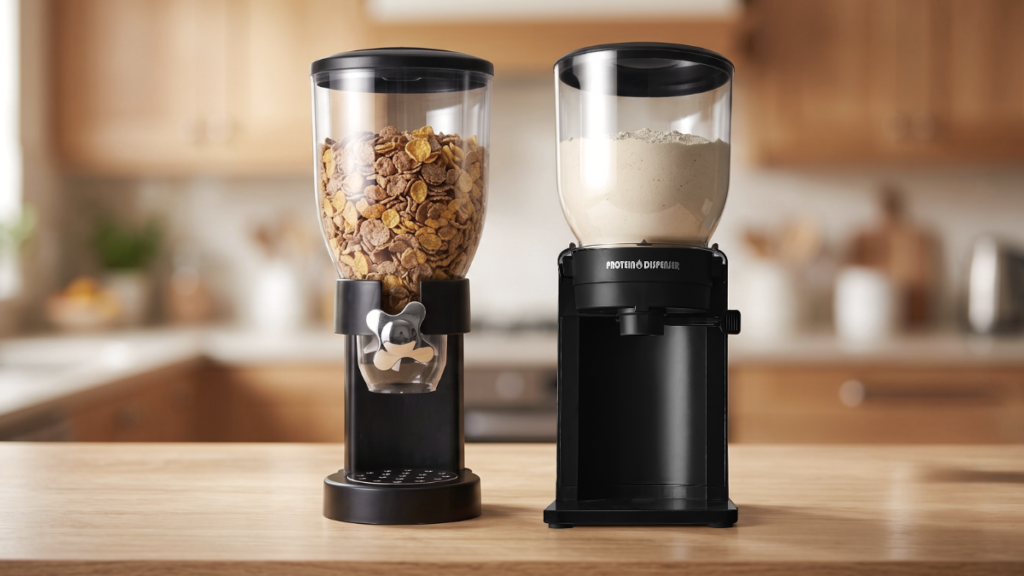
Why Do Cereal Dispensers and Protein Dispensers Look So Alike?
Because they’re built on the same idea: hold the contents in a clear hopper on top, work a handle or lever, and a set amount comes out the bottom. The resemblance is real.
A cereal dispenser lets you serve cereal, granola, nuts, or coffee beans a set amount at a time without touching them. The contents sit in the hopper. Turn the handle, and paddles inside scoop up a portion, carry it around to the outlet at the bottom, and drop it. The amount is set by how much the paddles scoop, which is volumetric dosing.
A protein dispenser looks much the same from the outside while it works. Work the lever, and a set dose drops into the shaker below. Judged only on “a handle or lever releases a set amount”, the two do nearly the same thing. Add the clear hopper and the black body, and it’s no surprise some pairs look like twins.
So wondering “aren’t these the same?” isn’t a silly question. It’s the natural one. The difference isn’t in the shape or the motion you can see from outside. It’s in what the insides were designed to handle.
If They Look the Same, Are the Insides the Same?
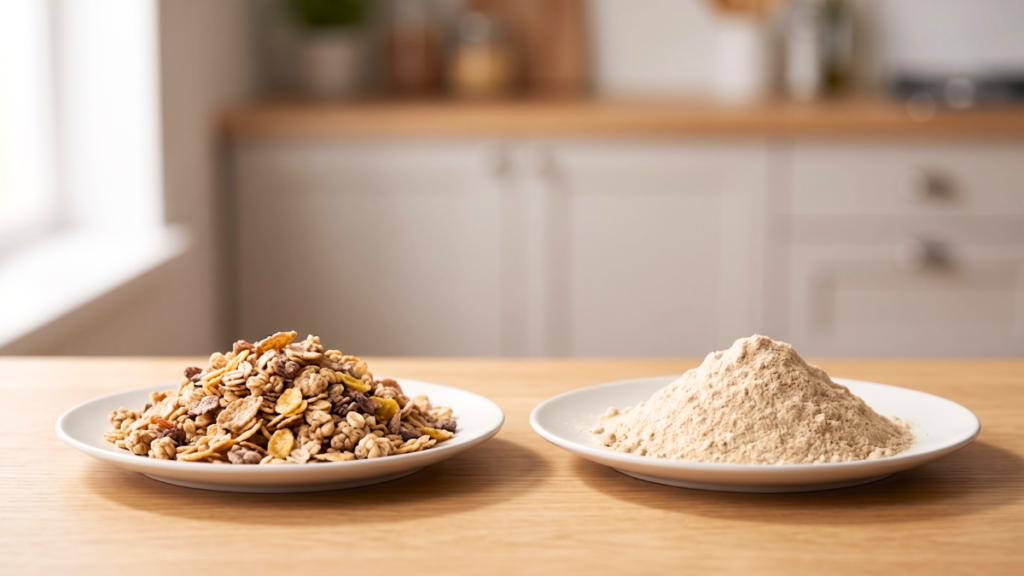
No. The insides of a cereal dispenser are built to move pieces. The paddles are rubber (silicone), a material chosen to scoop pieces gently. That’s where the fit with fine protein powder starts to diverge.
The paddles are rubber or silicone for two reasons. One is to scoop fragile pieces like cereal and granola without crushing them. The other is that the maker advertises the paddles sealing against the body to keep air out. For pieces, that’s good design.
And a cereal dispenser has nothing that stirs the contents of the hopper. There’s no agitator, because there’s no need for one: pieces roll toward the outlet on their own.
That’s where pieces and fine powder part ways.
- Pieces (cereal): There’s space between them, and they roll and flow. The paddles scoop them cleanly, and they drop cleanly.
- Fine powder (protein): The particles are far smaller, and they pile up rather than roll. Without something stirring, the powder tends to sit above the outlet.
A cereal dispenser is a well-made tool for dispensing pieces. It looks good, you can see what’s inside, and it spares you the bag or box every morning. Wanting one in your kitchen makes sense. The problem isn’t the quality of the tool. It’s putting a fine powder, which behaves differently, into insides built for pieces.
What Happens If You Put Protein Powder in a Cereal Dispenser?
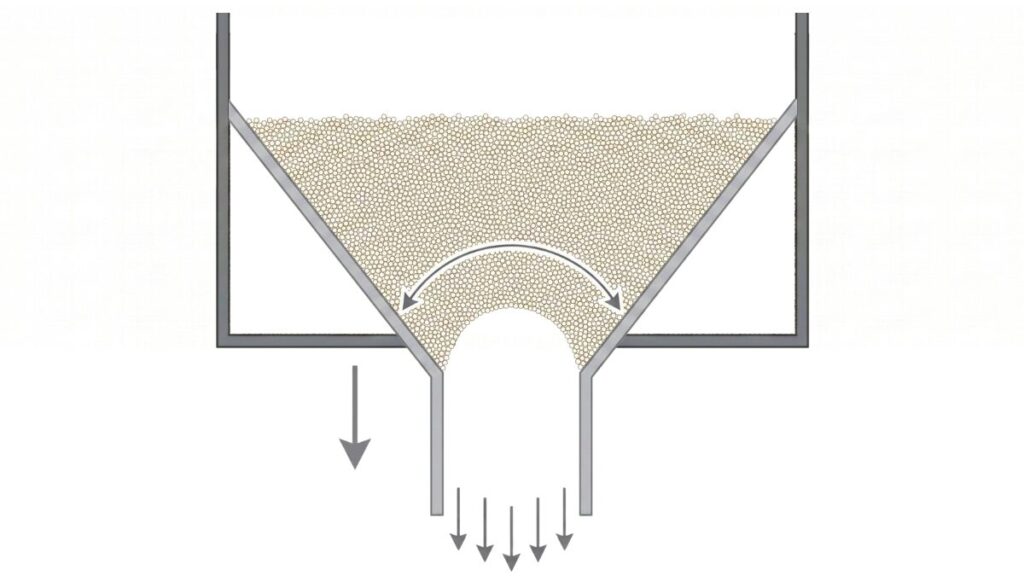
A free-flowing powder may come out. But we’d expect a fine powder to arch over the outlet and stop dropping, or to trickle out through the gap between the paddles and the body. There’s no agitator, and the parts were designed around pieces.
To be clear, it can work. A fresh, free-flowing protein might come out reasonably well. It depends on the product and the state of the powder, so I can’t say flatly “it will never come out”.
That said, things that rarely happen with pieces are likely to happen with fine powder.
The powder builds a “bridge” in the hopper and stops dropping (bridging)
Fine powder can form an arch above the outlet, so nothing drops even though there’s empty space below it. This is called bridging. Pieces roll and fall; fine powder piles up and stays put. An agitator would break the arch, but a cereal dispenser doesn’t have one, so fine powder is likely to have trouble dropping. (This is separate from clumping caused by moisture. It can happen with dry fine powder too.)
People must have tried it, but “it didn’t come out well” isn’t the kind of thing that gets posted. A tool that didn’t work just gets quietly put away.
Fine powder leaks through the gap between the paddles and the body
The cereal dispenser’s maker advertises the paddles sealing against the body to keep air out. That seal, though, was designed with pieces in mind. Pieces are big enough that they can’t get through a gap. Fine protein powder can find its way through the small gap between paddles and body and trickle out.
To be fair, protein dispensers share this weakness. Once you’re handling fine powder, getting a gap down to zero is not easy. Even so, a cereal dispenser, with a seal designed around pieces, is likely to leak fine powder more.
So Why Does Protein Need a Purpose-Built Dispenser?
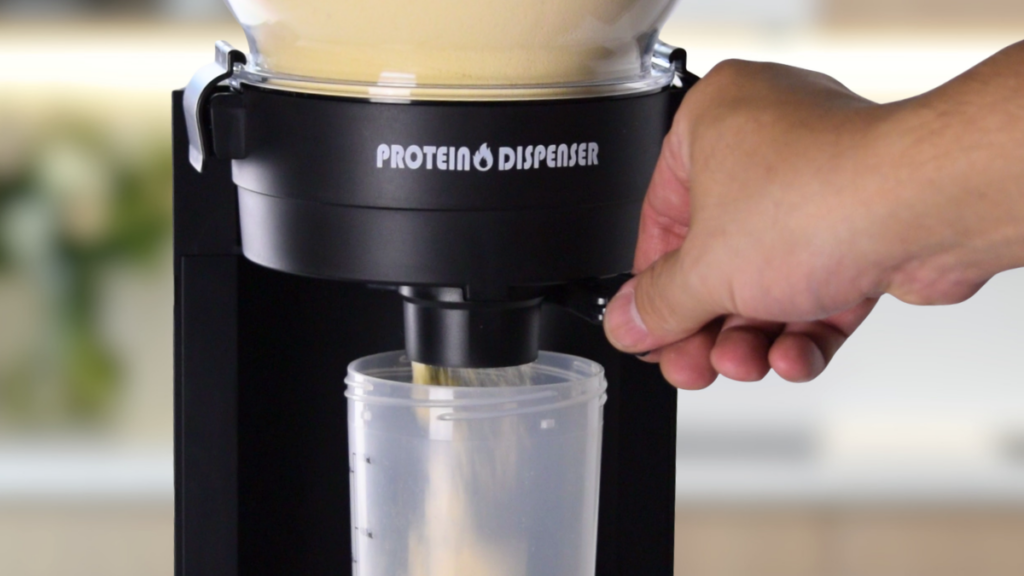
Because a protein dispenser’s mechanism was built around powder: it has to dispense a set amount without clogging, and with little spilling. From the outside, they look alike. This inside work is what makes it a different kind of product.
Just as a cereal dispenser is optimized for pieces, a protein dispenser is optimized for fine powder. We worked through the two problems above, powder not dropping and powder leaking through gaps, on real units, one at a time.
- Stir it to drop it: An agitator in the hopper turns with the lever and keeps the powder moving, so it stays free-flowing near the outlet. It’s there to stop bridging, and a cereal dispenser has nothing like it.
- A set amount every time: Powder in the dosing chamber is leveled off by the leveling edge as it rotates, which keeps the dose consistent from pull to pull. You can’t set it to a number of grams, but for a given powder, you get roughly the same amount every time.
- An enclosed path, no extra powder: a cover keeps the dose being measured separate from the powder in the hopper, so nothing extra drops in.
- Comes apart for washing: Fine protein powder contains fat, so we designed it to be washed.
Getting “a set amount, without clogging, the same every time” to work with fine powder was the part that took the longest. The dosing mechanism alone went through 19 prototypes. I’ve written about that process in 19 Prototypes to a Dosing Mechanism.
That work on fine powder is what the patent recognizes: the dosing mechanism is registered as Japan Patent No. 7580860 (pending in the U.S.). The technical details are in Inside Our Patented Dosing Mechanism. And to confirm it would hold up to 5 years of daily use, it has also passed a roughly 25,000 cycle endurance test.
The two dispensers look alike, and I think the price gap comes down to this difference in what’s inside. The same thing happens with lever-type rice dispensers, the containers Japanese households use to measure out rice one rice cup (about 180 ml / 6 fl oz) at a time. I’ve compared those with protein dispensers separately.
In Summary: Alike on the Outside, Built for Different Things Inside
Cereal dispensers and protein dispensers look alike and move alike. The insides are still different things.
- Both are volumetric dosing tools: a clear hopper, a handle or lever, a set amount out. The lookalike part is true.
- A cereal dispenser is for pieces. Its paddles are rubber (silicone) so they scoop without crushing, and there’s no agitator. Pieces roll and drop, so none is needed.
- Put fine protein powder in one, and we’d expect it to bridge above the outlet and stop dropping, or to leak through the gap between the paddles and the body (protein dispensers share the gap weakness, but a cereal dispenser built for pieces is likely to leak fine powder more).
- A protein dispenser is a tool whose mechanism was built to dispense fine powder in a set amount, without clogging, and with little spilling. That inside work is why, for all the resemblance, it’s a different tool. The dosing mechanism went through 19 prototypes and is registered as Japan Patent No. 7580860.
For the background on powder that cakes or clumps and won’t come out, I’ve also covered the 2 causes of protein clumps separately.
Related reading:
- 19 Prototypes to a Dosing Mechanism: The Engineering Behind the Protein Dispenser
- Inside Our Patented Dosing Mechanism: How the Protein Dispenser Stops Leaks and Doses Consistently
The ALENNE Protein Dispenser
The ALENNE Protein Dispenser is Miaomada’s flagship product: pour straight from the bag or tub into the hopper, slide the lever to measure a set dose, and keep it on the counter as part of your daily routine.
Its patented dosing mechanism, the part this article is about, was built around fine powder: an agitator to keep it moving, a dosing chamber leveled off for a consistent dose, and parts that come apart for washing. If daily dosing and keeping your hands off the powder are what you want a container to solve, that’s what it was built for.